
UK expat business setup in Dubai and moving a company from Germany to the UAE offer something genuinely rare: a country with no personal income tax, a founder-friendly corporate tax regime, and a real, functioning legal system to back it up. That opportunity is real, and it’s why this move continues to make sense for exactly the kind of established UK and European founder reading this. Keeping it, in full, for the long term, depends on getting three specific things right on the way out: Germany’s exit tax on company shares, the UK’s inheritance tax rules since April 2025, and the UAE Tax Residency Certificate you’ll actually rely on to prove your new status. None of these are reasons not to make this move. They are exactly what separates a founder who makes this move once, cleanly, from one who has to revisit it. Here is how to get the exit right.
Quick Navigation
Quick Answer
- Germany’s exit tax (Wegzugsteuer, under Section 6 AStG) taxes unrealised gains on shares of 1% or more in a GmbH or AG the moment German tax residency ends, at an effective rate of roughly 26.375%.
- A 2026 reform made this materially worse for moves to non-EU/EEA destinations like the UAE: interest-bearing instalments over five years with collateral required, versus more favourable terms for EU-internal moves.
- Since April 2025, UK inheritance tax is residence-based, not domicile-based. A “long-term resident” (UK resident in 10 of the last 20 tax years) remains exposed to 40% UK IHT on their worldwide estate for 3 to 10 years after leaving, and the UAE’s zero inheritance tax provides no shelter during that tail.
- A UAE Tax Residency Certificate obtained via the 90-day domestic route is frequently not valid for actual treaty purposes with the UK or Germany, both of which generally require the 183-day threshold.
- Offshore holding structures can play a genuine role in this planning, but only when built around the specific exit tax and residence-tail exposure a European founder actually faces, not as a generic asset-protection product.
UK Expat Business Setup in Dubai: Germany’s Exit Tax on Shares You Haven’t Sold
For anyone weighing this move alongside a German exit, start here, because this is the single most consequential fact for a German founder considering the UAE, and it is routinely underplayed.
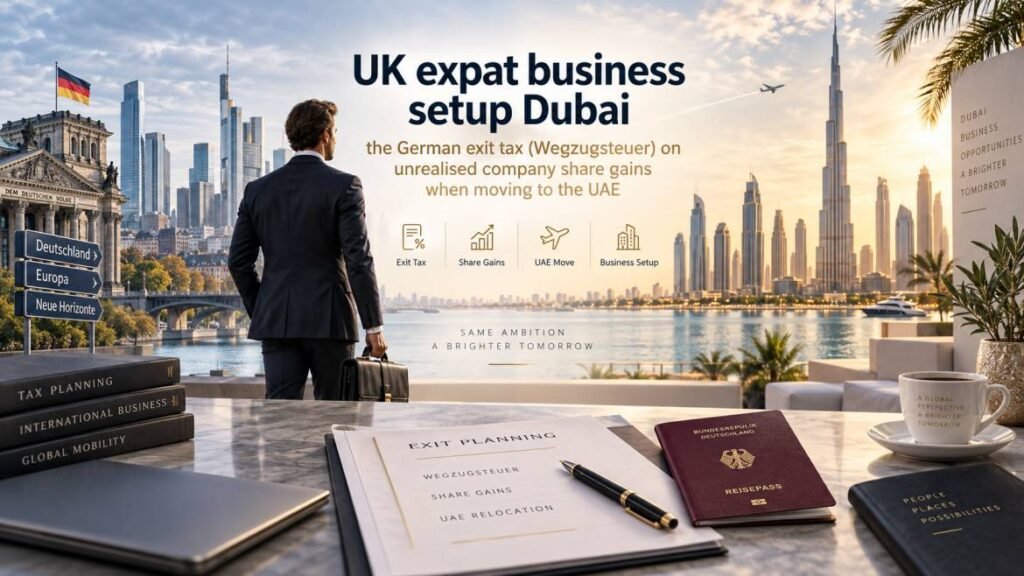
Germany’s exit tax, the Wegzugsteuer under Section 6 of the Außensteuergesetz (AStG), applies when an individual who holds 1% or more of the shares in a corporation, a GmbH, AG or similar, ends their German tax residency. The mechanism is a deemed disposal: the law treats you as though you sold your shares at fair market value on the day you leave, and taxes the resulting gain, even though no actual sale has taken place and no cash has changed hands. After the Teileinkünfteverfahren partial-income procedure applies, the effective rate on the gain commonly lands around 26.375%.
Sources differ on the exact residency-history threshold that triggers eligibility, with some describing 7 of the last 12 years and others 10 of the last 12 years of German tax residency as the qualifying period. Confirm your specific position with a German tax adviser rather than relying on either figure as settled. What is consistent across sources: this is not a broad departure tax on all your assets. It is specifically targeted at meaningful company shareholdings, not real estate or general securities portfolios, which is a narrower and more predictable trigger than some other countries’ exit tax regimes, but a serious one if it applies to you.
Why the 2026 Reform Makes the UAE Move Specifically Harder
For anyone planning UK expat business setup in Dubai or a German exit, this is the part that changed recently, and it changes the calculation specifically for a move to the UAE rather than to another EU country.
Moving from Germany to another EU or EEA country generally still allows more favourable deferral terms. Moving to a non-EU/EEA destination, which includes the UAE, is treated differently: as of the 2026 framework, the tax becomes payable over five years, interest-bearing, with collateral required, a meaningfully harsher position than the interest-free instalment terms available for EU-internal relocation. If you are weighing the UAE specifically against an EU relocation on tax grounds alone, this is a real, current difference to put in front of a qualified adviser before deciding, not an incidental detail.
A second, separate trap worth knowing: Germany’s extended limited tax liability (erweiterte beschränkte Steuerpflicht) can continue to apply certain German taxation to specific German-source income even after you have successfully ended German tax residency, a rule specifically aimed at moves to low-tax jurisdictions like the UAE. And ending residency itself requires more than deregistering: German tax authorities look at whether you have genuinely given up any German home available to you, not just filed an Abmeldung, since a dwelling that remains available to you can undermine the residency break even if you are living in the UAE most of the time.
UK Expat Business Setup in Dubai: Leaving Does Not End Your Inheritance Tax Exposure
This is the finding that surprises most founders, because it runs against the natural assumption that leaving a country ends your tax relationship with it.
Since 6 April 2025, UK inheritance tax no longer depends on domicile. It depends on residence. If you have been UK resident in at least 10 of the previous 20 tax years, you are classified as a long-term resident, and your entire worldwide estate sits inside the UK’s inheritance tax net at 40%, regardless of where you subsequently live. Leaving the UK, even for a country with zero inheritance tax like the UAE, does not switch this off immediately. A long-term resident who departs remains exposed for a tail of 3 to 10 years, with the exact length depending on how many of the last 20 years were spent UK resident: 10 to 13 years of residence gives a 3-year tail, and each additional year of prior residence adds a further year, capped at 10.
The UAE’s own zero inheritance tax is genuinely true and genuinely irrelevant to this specific exposure, since the UK’s claim during the tail is not affected by what the destination country charges. For a founder with meaningful UK assets, or worldwide assets built up while UK resident, this tail is worth planning around specifically, not treated as an afterthought once the more visible income tax question is settled.

The UK Statutory Residence Test, and the Trap Most People Don’t See Coming
Since the UK abolished domicile as the basis for income tax and capital gains tax status, the Statutory Residence Test (SRT) is now the sole legal mechanism for determining whether you remain UK tax resident. It works through three ordered stages: automatic overseas tests, automatic UK tests, and a sufficient-ties test, applied in that order until one gives a clear answer. A founder working full-time overseas who keeps UK visits under roughly 90 days, with no more than 30 workdays, typically passes on the automatic overseas test.
The trap worth knowing directly, because it catches people who have genuinely relocated: a UK property that remains available to you, even one you are actively trying to sell and are not living in, can still count as your home for SRT purposes. A founder who has moved to the UAE, is living in temporary accommodation there, but still owns an unsold UK property, can trigger UK tax residency again simply by returning and staying in that property for a matter of weeks, because temporary overseas accommodation may not qualify as a proper overseas home in the same way the UK property still does. The practical lesson: resolve what happens to any UK property you retain, and how you use it if you return, as part of the relocation plan itself, not as a detail to sort out afterward.
The UAE Tax Residency Certificate “Shortcut” That Doesn’t Hold Up
For both UK and German founders alike, this is where the two threads meet, and where a genuinely common mistake happens.
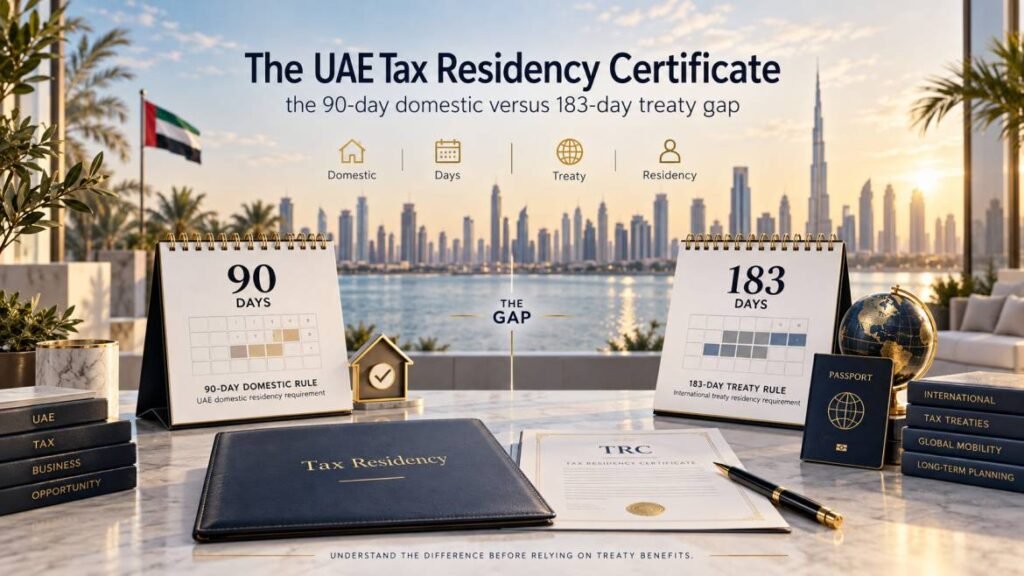
As part of any UK expat business setup in Dubai plan, the UAE offers more than one route to a domestic Tax Residency Certificate (TRC). The most commonly cited is the 90-day physical presence test, combined with holding a valid UAE residence permit and either a permanent place of residence or employment or business activity in the UAE. This route genuinely establishes UAE tax residency under UAE domestic law. The trap is assuming it is automatically sufficient for what you actually need the certificate for: proving to HMRC or the German Finanzamt, under the relevant double taxation agreement, that you are now a UAE tax resident for treaty purposes. Most DTAs, including the UAE’s treaties with the UK and Germany, generally default to the 183-day physical presence threshold or OECD tie-breaker rules for this purpose, not the domestic 90-day route.
Present a 90-day domestic TRC to a foreign tax authority expecting treaty relief, and it can be rejected outright. As of 2026, the FTA’s own EmaraTax platform has been built to flag exactly this mismatch: selecting “Treaty Purpose” during application now cross-references the specific DTA’s requirements, and an application can be blocked if your presence days fall short of what that treaty demands. A related, separately important point: holding a Golden Visa does not by itself establish UAE tax residency. It is an immigration status, assessed independently by the FTA from the physical presence and centre-of-interests tests that actually determine tax residency.
Procedurally, the process has also changed recently: since Cabinet Decision No. 174 of 2025, paper TRCs have been abolished in favour of electronic certificates carrying a dynamic, scannable verification code, and individuals can now apply as soon as they meet the relevant day threshold within the active tax period, rather than waiting until year-end. Fees currently run around AED 50 for submission plus AED 500 to 1,750 depending on your tax registration status, with an optional AED 250 for a hard copy.
Where Offshore Holding Structures Genuinely Fit
For UK and German founders alike, an offshore holding company in the UAE, structures like RAK ICC or a JAFZA offshore entity, is a real and sometimes genuinely useful tool in this context, and it is also frequently sold as a generic product disconnected from the specific exposure a founder actually has.
The honest fit: a UAE holding structure can be useful for consolidating ownership of shares in an operating business, for succession and estate planning purposes going forward, and for separating personal asset holding from an operating company’s trading risk. What it does not do on its own: retroactively undo a German exit tax charge already triggered by ending German residency, or shelter a UK long-term resident from the inheritance tax tail during the years it applies. The structure has to be built around your actual exposure and timeline, ideally before residency changes trigger the exit tax or before the move that starts the IHT tail clock, not layered on afterward as a fix.
For the broader UAE company structure decision generally, mainland, free zone or offshore, see mainland vs free zone vs offshore in the UAE, and for the residency side of this decision, the UAE Golden Visa guide covers current eligibility in detail.
My Approach: Planning the Exit Before You Make It
Most business setup consultants help you register a company. I help you make informed business decisions before you invest, and this move is exactly the kind of decision where that distinction matters.
When it comes to UK expat business setup in Dubai, the founders who run into real trouble are rarely the ones who moved to the UAE for the wrong reasons. They’re the ones who treated the move as a clean, one-directional break, sorted the UAE side properly, and only discovered the exit tax, the inheritance tax tail, or the TRC mismatch after the fact, when the options for managing it were far more limited than they would have been with a year of lead time. Sequencing the German or UK exit correctly, alongside the UAE setup, is what actually determines whether this move achieves what it was meant to.
My advisory process focuses on helping you reduce uncertainty and make confident decisions, not just complete documentation. In practice:
- Coordination with your UK or German tax adviser on the exit-side exposure, exit tax, residency break requirements, or the IHT tail, before the UAE side is finalised.
- TRC planning built around what you actually need the certificate for, domestic UAE purposes or a specific treaty claim, rather than assuming the fastest route is automatically sufficient.
- Honest assessment of whether an offshore holding structure genuinely fits your situation, and the right timing for it relative to your residency change.
- Business setup and licensing execution sequenced correctly against your personal residency and tax timeline.
- Golden Visa advisory for the long-term UAE residency side of the move, kept clearly distinct from your tax residency position.
- Corporate tax registration and filing planning for the UAE entity itself, once the structure and timing are confirmed.
The objective is simple: help you make this move with clarity and confidence, having actually planned for what happens on both sides of it, not just the UAE side.
If you’re a UK or European founder, including from Germany, planning a move to the UAE and want the full picture confirmed before you commit, get in touch.
Frequently Asked Questions
Does Germany really tax gains I haven’t realised yet?
Yes, for company shareholdings above 1%. Germany’s exit tax under Section 6 AStG treats ending German tax residency as a deemed disposal of your shares at fair market value, taxing the resulting gain at an effective rate of roughly 26.375%, even though no actual sale has occurred.
Is moving from Germany to the UAE treated the same as moving within the EU?
No. A 2026 reform made moves to non-EU/EEA destinations like the UAE meaningfully harsher: the exit tax becomes payable over five years, interest-bearing, with collateral required, compared with more favourable terms for moves within the EU or EEA.
Does leaving the UK end my UK inheritance tax exposure immediately?
Not necessarily. Since April 2025, UK inheritance tax is residence-based. A long-term resident, UK resident in at least 10 of the previous 20 tax years, remains exposed to 40% UK inheritance tax on their worldwide estate for 3 to 10 years after leaving, regardless of the destination country’s own inheritance tax rules.
Can a UAE Tax Residency Certificate always be used to claim UK or German treaty relief?
Not always. A TRC obtained via the UAE’s 90-day domestic route establishes UAE tax residency under UAE law but is often insufficient for treaty purposes, since most double taxation agreements, including with the UK and Germany, generally require the 183-day threshold. The FTA’s own EmaraTax platform now checks for this mismatch on treaty-purpose applications.
Does a UAE Golden Visa make me a UAE tax resident automatically?
No. A Golden Visa is an immigration status. UAE tax residency is a separate determination made by the Federal Tax Authority based on physical presence or centre-of-interests tests, which must be independently satisfied regardless of your visa status.
Can an offshore holding company undo an exit tax charge or the UK inheritance tax tail?
No, not retroactively. An offshore holding structure can be a genuine part of ownership and succession planning going forward, but it does not reverse a German exit tax charge already triggered, or shelter a UK long-term resident from the inheritance tax tail during the years it applies. Timing, built around your actual exposure, is what matters.
How much UK tax-free presence do I get before triggering residency again after leaving?
It depends on your specific ties under the Statutory Residence Test, not a single fixed number. A common threshold for someone with no remaining UK ties is under 16 days in a tax year, rising to around 90 days for those working full-time overseas, but a retained, available UK home can complicate this regardless of day count.