Global bond yields climbed to their highest levels in decades this week. The US 30-year Treasury yield touched levels last seen in 2007. UK 30-year gilt yields hit their highest since 1998. German Bund yields reached levels not seen since 2011, and Japanese government bond yields rose to their highest since 1996. This is a genuinely significant fiscal story, and it is being covered almost entirely as a financial-markets story. It deserves to also be read as a jurisdiction story. For globally mobile individuals and business owners, rising sovereign yields are a direct signal about the fiscal position of the countries issuing them, and that signal is exactly what makes reviewing long-term residency and tax structure a rational decision right now, not a reactive one.
Quick Navigation
Quick Answer
- Global bond yields hit their highest levels in decades this week, with the US 30-year Treasury near 5.3%, UK 30-year gilts at 5.89%, and Japanese 10-year JGB yields at their highest since 1996.
- The sell-off reflects rising government debt issuance, persistent inflation, and reduced expectations of near-term rate cuts across major economies, not a single country’s isolated problem.
- Rising sovereign yields raise the cost of servicing existing government debt, and historically, governments facing that pressure have used tax policy as one available lever, a pattern worth planning around, not a specific prediction.
- The UAE’s fiscal position is structurally different: 0% personal income tax, corporate tax only above AED 375,000 profit, and government finances backed by sovereign wealth reserves in the trillions of dollars, not rising debt-service costs.
- The UAE’s Golden Visa now carries no minimum-stay requirement, making long-term residency a genuine optionality decision rather than a full relocation commitment.
Global Bond Sell-Off UAE Residency: What Actually Happened in Bond Markets This Week
In the global bond sell-off UAE residency context, it is worth stating the numbers precisely, since they make the case better than any summary of them.
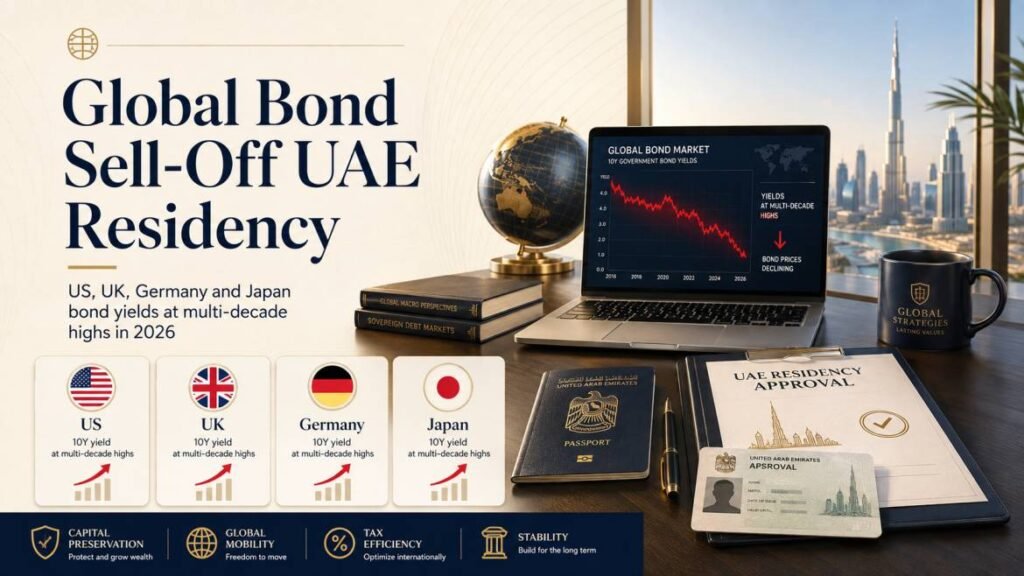
In the first days of September 2026, global bond yields climbed sharply across every major market. The US 10-year Treasury yield rose to around 4.78%, and the 30-year Treasury yield reached roughly 5.3%, its highest level since 2007. In the UK, 10-year gilt yields surged past 5.2%, their highest since the 2008 financial crisis, while 30-year gilts touched 5.89%, a level not seen since 1998. Germany’s 10-year Bund yield climbed to its highest since 2011, and France’s 10-year yield reached its highest since 2008. In Asia, Japan’s 10-year government bond yield rose to its highest since 1996.
The immediate triggers named across financial press coverage: renewed conflict in the Middle East pushing oil prices higher and reigniting inflation concerns, hawkish signalling from the US Federal Reserve under Chair Kevin Warsh, and, underlying all of it, record levels of government borrowing. The global bond market is valued at roughly USD 109 trillion, and governments and companies are expected to borrow a record USD 29 trillion through bond markets in 2026 alone.
Why This Is a Fiscal Story, Not Just a Markets Story
The framing matters for anyone weighing the global bond sell-off UAE residency question, because a fiscal story has direct implications for where you choose to be based and how your affairs are structured, while a markets story, on its own, does not.
Government bond yields rise when investors sell bonds and demand a higher return to keep holding government debt. That is, in plain terms, investors pricing in more risk and more inflation into the cost of a government borrowing money. Japan illustrates the pressure clearly: government debt now exceeds 200% of GDP, and debt servicing is estimated to account for more than 25% of government expenditure in fiscal year 2026. The United States carries national debt above USD 40 trillion, with a federal deficit projected at roughly USD 1.9 trillion for the current fiscal year. The UK, France and Germany are each dealing with their own versions of the same underlying pressure: elevated debt, persistent inflation, and markets demanding a higher premium to hold that debt for the long term.
One detail worth noting directly: sovereign government bonds have traditionally been treated as a safe-haven asset during periods of geopolitical stress. This sell-off is happening alongside renewed geopolitical tension, not despite it, a genuine shift in how markets are pricing sovereign risk that several analysts have flagged directly.
The Historical Link Between Debt Stress and Tax Policy
This is the part of the argument that needs to be stated carefully, since it is a historical pattern, not a prediction about any specific country’s future tax policy.
This is the crux of the global bond sell-off UAE residency argument: when a government’s debt-servicing costs rise, meaning more of its budget goes toward interest payments rather than services or investment, that government has a limited set of levers available: cut spending, grow the economy faster than the debt, borrow even more, or raise revenue, which commonly means tax policy. This is not a claim about what any specific government will do next. It is an observable historical pattern: periods of sustained fiscal pressure have, across many countries and many decades, coincided with tax policy becoming more, not less, active as a government tool.
For a globally mobile individual or business owner, the practical implication is not to predict a specific tax change in a specific country. It is to recognise that jurisdiction and tax-residency planning is a genuinely rational thing to review during a period when major economies are visibly under this kind of fiscal pressure, rather than something to address only after a specific policy change has already happened.
Global Bond Sell-Off UAE Residency: Where the UAE’s Fiscal Position Actually Differs
The comparison only means something if it is grounded in real numbers, not a general “low tax” reputation.
The UAE levies 0% personal income tax on salary and most personal income. Corporate tax applies at 9% only above AED 375,000 in annual profit, with a 0% rate structure available to qualifying free zone businesses on qualifying income. This is not a government running a structural deficit and looking to close a funding gap through the tax system. The UAE’s federal and emirate-level finances are backed substantially by sovereign wealth reserves; state-owned investment assets across the UAE’s major institutions total in the trillions of dollars, a fundamentally different fiscal foundation than a government financing its operations primarily through rising sovereign debt issuance. The broader picture of how the UAE’s sovereign wealth position compares globally is covered in how UAE sovereign wealth dominates global investment rankings.
This is also not a new or reactive trend. Henley & Partners’ Private Wealth Migration research has tracked the UAE as the world’s leading destination for high-net-worth individual relocation since 2023, with a forecast net inflow of nearly 9,800 relocating millionaires in a single recent year, more than any other country including the United States. The current bond sell-off does not create this dynamic. It sharpens the reason behind a trend that was already well underway.
Why Long-Term Residency Is the Practical Response, Not a Full Relocation
In the global bond sell-off UAE residency picture, this distinction matters, because reviewing your jurisdiction position is not the same decision as uprooting your life, and treating it that way is what stops most people from acting on it at all.
For the global bond sell-off UAE residency question specifically, the UAE’s Golden Visa now carries no minimum-stay requirement to maintain residency, a genuinely significant change from earlier versions of the programme. That means securing long-term UAE residency, through property investment, business ownership or other qualifying routes, functions as optionality: a real, usable base with a genuinely different tax and fiscal profile, without requiring you to relocate your entire life immediately or maintain a physical presence you cannot commit to. Full detail on the current eligibility categories, including the rule that changed in February 2026, is covered in the UAE Golden Visa guide.
Treating this as optionality rather than an all-or-nothing decision is precisely why reviewing it now, while fiscal pressure is visible but before any specific policy response has materialised anywhere, is the more useful timing than waiting for a reason that feels more urgent.

0% Tax Structures: What Actually Applies, and to Whom
Any global bond sell-off UAE residency conversation eventually reaches tax structure. The UAE’s 0% tax positioning is real and it is also conditional, and conflating “0% tax country” with “0% tax regardless of structure” is a common, costly mistake.
Personal income tax genuinely does not apply to salary or most personal income for UAE residents. For business income, the 0% corporate tax rate is not universal; it applies specifically to qualifying free zone businesses on qualifying income, under conditions that differ by activity and free zone. Getting this structure wrong, whether by assuming free zone status alone guarantees 0% tax or by choosing the wrong jurisdiction for your specific activity, is where the actual value of proper structuring lies. The full comparison between mainland, free zone and offshore structures, and what genuinely determines the right one for a given business, is covered in mainland vs free zone vs offshore in the UAE, and a practical breakdown of free zone costs by emirate is in cheapest free zones in the UAE by emirate.
My Approach: Reviewing Your Position Before It Becomes Urgent
Most business setup consultants help you register a company. I help you make informed business decisions before you invest, and the global bond sell-off UAE residency question is exactly the kind of decision where that distinction matters.
The people who benefit most from a period like this are rarely the ones who react to a specific policy change after it happens. They are the ones who reviewed their jurisdiction and tax-residency position while the fiscal pressure was visible but before any single country had actually moved, giving them time to structure properly rather than scramble. A bond sell-off is not, on its own, a reason to make a decision. It is a legitimate reason to review one you may have been putting off.
My advisory process focuses on helping you reduce uncertainty and make confident decisions, not just complete documentation. In practice:
- Honest assessment of whether long-term UAE residency genuinely fits your situation, as optionality, not as a reactive move.
- Clear guidance on which business structures actually qualify for 0% corporate tax treatment, rather than assuming free zone status alone is sufficient.
- Golden Visa advisory matched to the eligibility category that actually fits your circumstances.
- Business setup and licensing structured correctly from the outset for the tax position you are actually trying to achieve.
- Corporate tax registration and filing planning that accounts for your specific activity and structure, not a generic assumption.
The objective is simple: help you review your position with clarity and confidence, on your own timeline, rather than under pressure created by someone else’s fiscal decisions.
If the current fiscal backdrop has you reconsidering where you and your business are based, get in touch for an honest assessment of what actually applies to your situation.
Frequently Asked Questions
What actually happened in the global bond sell-off?
In the global bond sell-off UAE residency story, global bond yields rose sharply in early September 2026 to their highest levels in decades across major markets. US 30-year Treasury yields approached 5.3%, UK 30-year gilts reached 5.89%, and Japanese 10-year government bond yields hit their highest since 1996, driven by rising government debt issuance, an oil-price shock, and reduced expectations of near-term interest rate cuts.
Does a bond sell-off mean my home country will raise taxes?
Not necessarily, and this article does not predict that for any specific country. It is a historical pattern that governments facing rising debt-servicing costs have used tax policy as one available lever, which makes reviewing your own jurisdiction and tax-residency position a rational thing to do during a period of visible fiscal pressure, not a prediction about any particular outcome.
How is the UAE’s fiscal position different from countries facing bond market pressure?
The UAE levies 0% personal income tax and only 9% corporate tax above AED 375,000 in profit, with government finances substantially backed by sovereign wealth reserves rather than reliance on rising government debt issuance, a structurally different position from economies currently facing bond market pressure.
Do I need to fully relocate to benefit from UAE residency?
No. The UAE Golden Visa no longer carries a minimum-stay requirement to maintain residency, which means long-term UAE residency can function as optionality, a genuine base with a different tax and fiscal profile, without requiring an immediate, full relocation.
Does the UAE’s 0% tax apply to all businesses automatically?
No. Personal income tax genuinely does not apply to salary or most personal income. The 0% corporate tax rate applies specifically to qualifying free zone businesses on qualifying income, under conditions that vary by activity and free zone, not automatically to every business structure.
Is the UAE’s popularity with wealthy relocators a new trend caused by this bond sell-off?
No. The UAE has been the world’s leading destination for high-net-worth individual relocation since 2023, according to Henley & Partners’ migration research, with the current fiscal backdrop sharpening the reasoning behind an already well-established trend rather than creating it.