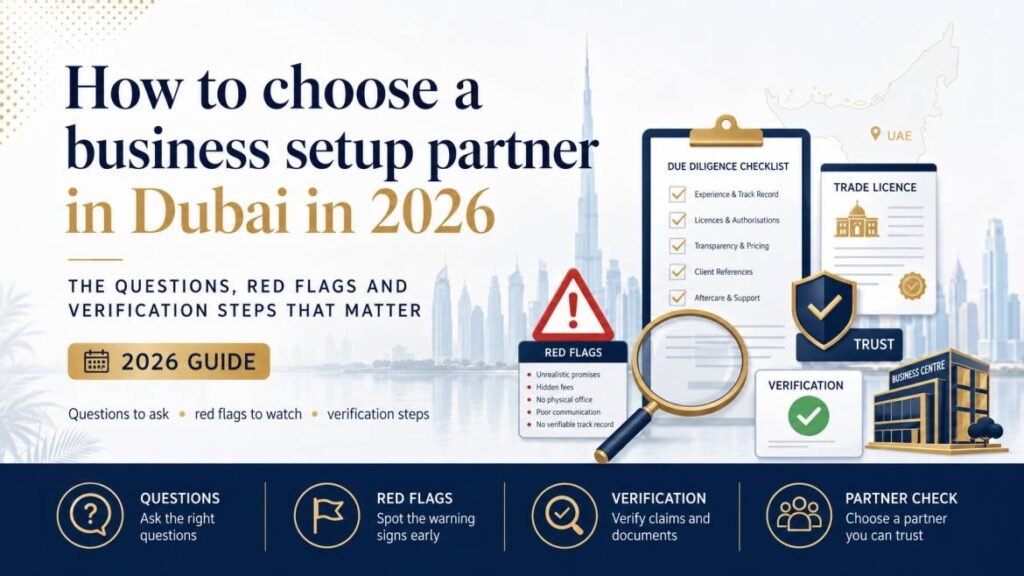
Search for how to choose a business setup partner in Dubai and you will find a dozen nearly identical checklists: check the fees, check the reviews, check the licence, avoid anyone who guarantees a bank account. All of that advice is correct and none of it explains the one thing worth knowing before you read any of it, including this article: several of the guides ranking for this exact topic are published by a business setup consultancy, sometimes citing a ranking that happens to place the publisher near the top of its own list. Here is a framework built around the one question that actually predicts most of the red flags every other guide lists separately, plus the practical verification steps almost none of them explain as an action.
Quick Navigation
Quick Answer
- The single most predictive question to ask before signing with anyone is what they are paid on. A consultant paid purely on formation volume has a structural incentive to move you toward signing quickly, and most of the red flags other guides list separately trace back to this one incentive.
- Verify any consultant’s Dubai Department of Economy and Tourism licence directly, under an activity such as Management Consultancies or Documents Clearing Services, before engaging them.
- “Years in business” is a reasonable but incomplete signal. It mechanically excludes newer, rigorous advisors, and should never be the only criterion you check.
- Beyond avoiding a bad consultant, the right partner should be able to explain how your structure and sector choice actually align with where the UAE’s own economic direction is heading.
The Question That Predicts Almost Everything Else
Every guide to choosing a business setup partner in Dubai lists roughly the same red flags: hidden fees, unrealistic timelines, vague pricing, a “guaranteed” bank account nobody can actually promise. These are all real warning signs. They are also symptoms, and almost no guide names the underlying cause.
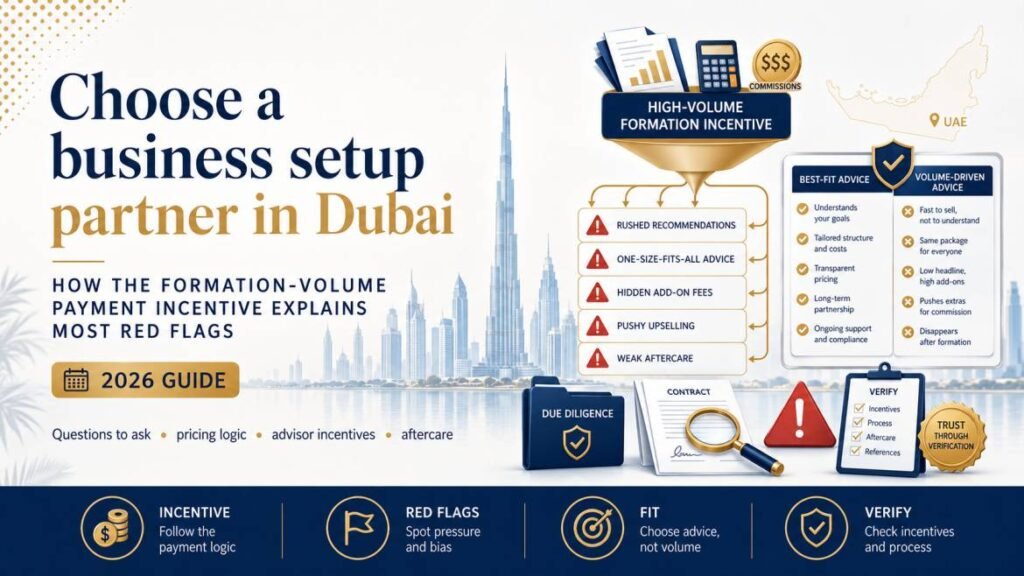
Most business setup consultants in the UAE are paid on formation volume. Every client who forms a company generates a fee, and that fee is largely the same whether the formation was genuinely the right decision or a premature one. That single structural fact explains the rushed timelines, the reluctance to say “you should wait,” and the incentive to upsell a package rather than diagnose whether the client’s plan actually works in this market.
So the single most useful question to ask before signing is not “what do you charge” or “how many years have you operated.” It is: what happens in this engagement if the honest answer is that I should not form a company yet? A consultant paid purely on formation has almost no incentive to give you that answer. A consultant structured around advisory value, where the relationship survives a client being told to pause, has a real one.
Ask this question directly in your first conversation. The answer, or the visible discomfort at the question, tells you more than any review score.
Choose a Business Setup Partner in Dubai Carefully: Why “Top 10” Lists Are the Least Trustworthy Content
This deserves to be said plainly rather than implied.
A meaningful share of the “top 10 business setup consultants in Dubai” and “how to choose a consultant” content ranking on Google is published directly by a consultancy, sometimes with that firm appearing inside its own ranking. At least one guide cites a separate third-party ranking as evidence of independent recognition, while that same ranking happens to place the publishing firm near the top of its own list. That is not necessarily dishonest. It is a genuine conflict of interest that the reader has no way to detect unless someone points it out, and almost nobody does.
This does not mean every comparison guide is worthless, including this one, which is itself published by a consultant. It means the correct response to any “best consultant” list, including implicit ones inside a “how to choose” article, is to check who published it and what they have to gain, before treating the ranking itself as evidence.
How to Actually Verify a Licence, Not Just Check for One
Nearly every guide on this subject tells you to “check the consultant is licensed.” Almost none tell you the actual step.
A legitimate business setup consultant operating in Dubai should hold a valid trade licence from the Dubai Department of Economy and Tourism, under an activity classification such as Management Consultancies or Documents Clearing Services. This is checkable directly, not something to take on trust from a website claim or a WhatsApp profile.
Authorities have specifically flagged unlicensed operators in recent years, including consultants running purely through social media with no verifiable physical office or registered trade licence. Before you hand over any document, deposit or payment, confirm the specific licence and activity directly rather than accepting a screenshot or a claim on a landing page. If a firm is reluctant to confirm this plainly, that reluctance is itself the answer.
Years in Business Is a Real Signal, and an Incomplete One
Several guides advise looking for five or more years of operation as a baseline filter. As a rough proxy for institutional stability, that is not unreasonable. As the only criterion, it has a real blind spot worth naming.
UAE regulation has changed meaningfully in the past few years, corporate tax, tightened AML expectations, evolving free zone and mainland rules, which means a firm’s tenure tells you how long it has existed, not necessarily how current its process is. A newer advisory practice built specifically around today’s regulatory environment can be more rigorous on the questions that matter now than a firm whose processes were set years before corporate tax existed.
The more useful question than “how many years” is “how do you keep your guidance current, and can you show me.” A specific, checkable answer, a stated research process, named primary sources, recent examples, tells you more than a founding date on its own.
The Question Almost Nobody Asks: Does This Partner Understand Where the UAE Is Heading
Every guide to this treats the decision as a vendor-selection problem: avoid fraud, get competent service, do not overpay. That is necessary and it is not sufficient.
The UAE is executing a stated national economic plan, We the UAE 2031, with specific published targets: growing GDP from AED 1.49 trillion to AED 3 trillion, raising non-oil exports to AED 800 billion, and lifting UAE foreign trade to AED 4 trillion. A business that forms with a sector and structure choice that happens to align with where the country is actually directing growth and incentive is not simply avoiding a bad consultant. It is starting from a genuinely stronger position than a business formed by a consultant who never considered that picture at all.
Ask a prospective partner directly whether they can explain how your specific sector and structure fit inside that national direction, not as background colour but as a factor in the actual recommendation. Most cannot, because most treat formation as a paperwork exercise rather than a strategic one. I go into this in full, including the specific targets and what they mean for structure and sector choice, in how my advisory aligns with the UAE’s national vision.
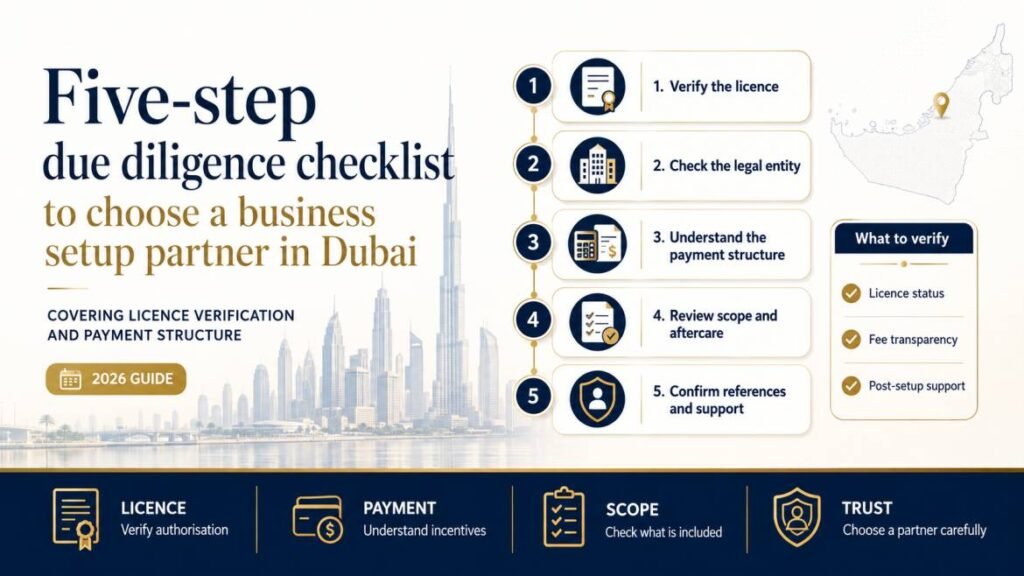
Choose a Business Setup Partner in Dubai: A Short, Real Due-Diligence Checklist
Pulling the above into four concrete steps you can use when evaluating candidates, in order.
- Ask what they are paid on, and specifically what happens in the engagement if the honest answer is that you should not form a company yet.
- Verify the DED licence and activity classification directly, rather than accepting a claim on a website or social profile.
- Ask how they keep guidance current, rather than relying on years in business alone.
- Ask them to explain how your specific structure and sector choice fit the UAE’s current economic direction, not as a sales line but as an actual factor in their recommendation.
A partner who answers all four directly and specifically is a genuinely different proposition from one who answers with reassurance instead of specifics.
{{IMG4}}
My Approach: I Help Businesses Understand and Participate in the UAE’s Economic Transformation
Most business setup consultants help you register a company. I help you make informed business decisions before you invest, which is exactly what should guide this decision.
That line, and the checks above, are not separate from each other. They describe the same thing from two directions. I am not paid on formation volume in a way that rewards rushing you toward a licence, my licensing and process are things I would rather you verify than take on trust, and the structural question I lead every engagement with is the same one this article opens with: whether forming now, in this structure, in this sector, is actually the right decision, not simply an available one.
I help businesses understand and participate in the UAE’s economic transformation. That is not a marketing line. It is the reason the sector and structure conversations I have with clients explicitly consider where the country’s own stated economic priorities sit, not as a footnote but as part of the actual recommendation.
My advisory process focuses on helping you reduce uncertainty and make confident decisions, not just complete documentation. In practice:
- Business idea validation and market research before any structure or licence conversation begins.
- Structure and sector recommendations that explicitly consider fit with the UAE’s stated national economic direction, not only your immediate preference.
- Transparent, itemised pricing with government fees and advisory fees stated separately.
- Business setup and licensing execution once the structure decision is sound, not before.
- Corporate tax, compliance and post-setup support, because the relationship does not end at licence issuance.
- A more detailed account of what makes this advisory different from a formation agent, and my full credentials and research process, is set out on why you can trust this advisory, and I make the fuller case for working with me specifically in choosing the best business consultant in the UAE.
The objective is simple: help you start your business with clarity, confidence and a long-term strategy, with a partner whose incentives you actually understand before you sign anything.
If you are trying to choose a business setup partner in Dubai and want to run the checks above against a real conversation rather than a website, get in touch.
Frequently Asked Questions on How to Choose a Business Setup Partner in Dubai
What is the most important question to ask a business setup consultant in Dubai?
What they are paid on, and specifically what happens if the honest answer is that you should not form a company yet. A consultant paid purely on formation volume has a structural incentive to move you toward signing regardless of whether that is the right decision, and this single factor explains most of the red flags other guides list separately.
How do I verify a business setup consultant’s licence in Dubai?
Confirm they hold a valid trade licence from the Dubai Department of Economy and Tourism under an activity such as Management Consultancies or Documents Clearing Services, checked directly rather than taken from a website claim or social media profile. Authorities have flagged unlicensed operators, including some running purely through social media.
Is a consultant with more years in business always better?
Not necessarily. Years in business is a reasonable signal of stability, but UAE regulation has changed significantly in recent years, so tenure alone does not confirm current, rigorous process. Ask specifically how a firm keeps its guidance current rather than relying on founding date alone.
What’s the difference between a business setup consultant and a formation agent in Dubai?
A formation agent processes what you ask for: licence type, visa count, package. A genuine consultant asks what you should be asking for in the first place: whether your revenue model has been tested in this market, whether your structure fits where you actually want to be in five years, and whether your sector choice aligns with where the UAE’s own economic direction is heading. The distinction shows up fastest in the first conversation. If every question is about your paperwork, you are talking to an agent. If the questions are about your business, you are talking to an advisor.
Are “top 10 business setup consultant” lists trustworthy?
Treat them with caution. A meaningful share of this content is published directly by a consultancy, sometimes appearing inside its own ranking, occasionally citing a third-party ranking that conveniently places the publisher near the top. Check who published any ranking and what they have to gain before treating it as independent evidence.
Why does the UAE’s economic direction matter when choosing a business setup partner?
Because a business formed with a structure and sector choice aligned with where the country is actually directing growth, under stated targets such as those in We the UAE 2031, starts from a stronger position than one formed without that consideration. Most consultants treat formation as a paperwork exercise rather than a strategic one, and asking about this directly reveals which kind you are dealing with.
What red flags should I watch for beyond pricing?
A guaranteed bank account approval, since no consultant can promise this; reluctance to confirm their DED licence and activity classification directly; and vague answers about what happens if their honest recommendation is to delay formation rather than proceed immediately.
A few specific red flags worth naming
Beyond the payment structure question, a handful of concrete signals are worth watching for directly. A consultant who cannot explain, in plain terms, why a specific free zone or activity code fits your business, and instead defaults to whichever option they sell most often, is optimising for their own catalogue rather than your situation. Pressure to sign within 24 or 48 hours, framed as a limited-time offer, is a sales tactic rather than a genuine regulatory deadline in the overwhelming majority of cases.
Vague answers about ongoing obligations are another signal. A consultant who can quote the licence price instantly but hesitates on renewal costs, visa renewal timelines, or what happens if your business activity changes after year one, is selling the transaction, not the relationship. Ask these questions before signing, not after, because the answers are far easier to get honestly upfront than to unwind later.
Whichever consultant you eventually choose, asking these specific questions upfront costs one conversation and saves months of correcting a structure that was never right for your business in the first place.