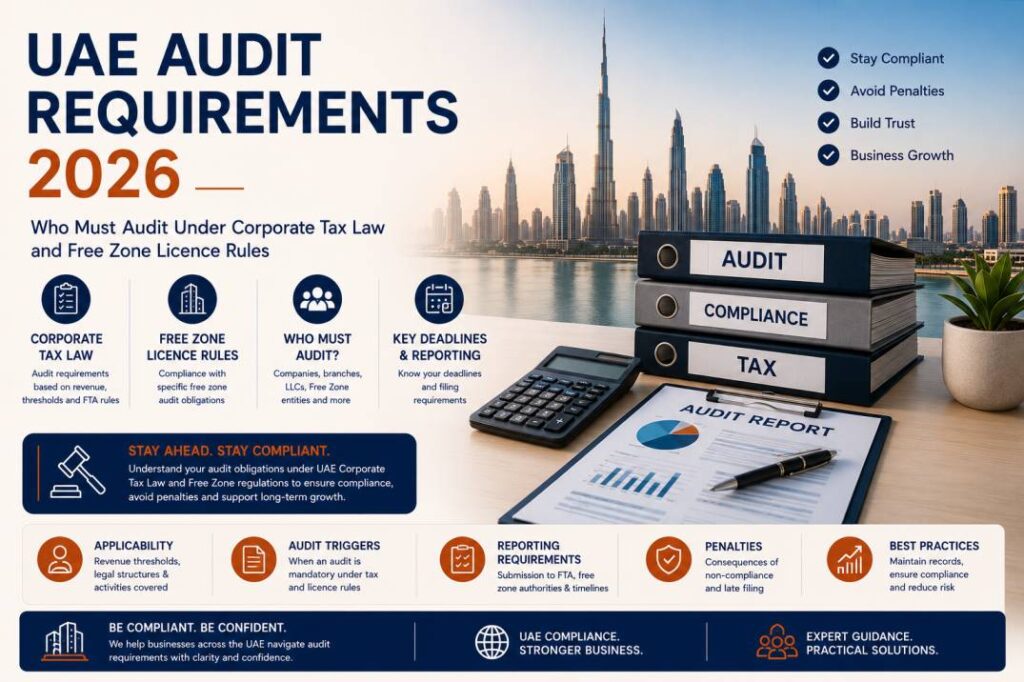
Search for UAE audit requirements and you will find the same three-item list everywhere: revenue over AED 50 million, Qualifying Free Zone Person status, or tax group membership. That list is accurate and it is also an incomplete answer to the question a founder is actually asking, which is simply do I need an audit. A company’s free zone or mainland authority can require an annual audit as a condition of keeping its licence, completely independent of the corporate tax rule, and almost no guide states plainly that these are two separate systems that can each apply on their own. Here is the full picture: what corporate tax law actually requires, what your licensing authority might require regardless, and the specific traps inside the tax group and QFZP rules that catch people out.
Quick Navigation
Quick Answer
- Under Ministerial Decision No. 84 of 2025, three categories must maintain audited financial statements for corporate tax purposes: any standalone taxable person with revenue over AED 50 million, every Qualifying Free Zone Person (QFZP) regardless of revenue, and every Tax Group, at the group level.
- This is separate from licensing authority audit requirements. Several free zones and mainland authorities require an annual audit as a condition of licence renewal, regardless of revenue or corporate tax status.
- Individual members of a Tax Group do not need standalone audited statements. The obligation sits at the group level through aggregated special purpose financial statements.
- For non-resident taxable persons, only revenue attributable to a UAE permanent establishment or nexus counts toward the AED 50 million threshold, not global revenue.
- A business below AED 50 million that is not a QFZP and not in a tax group has no corporate tax audit obligation, but may still need one under its licence terms, a bank covenant, or investor requirements.
UAE Audit Requirements: There Are Two Separate Systems, Not One
Every published list of UAE audit requirements describes the corporate tax trigger, and stops there. That is one of two systems that can independently require your company to have an audit, and treating it as the whole answer is the most common mistake I see.
System one: corporate tax law. Ministerial Decision No. 84 of 2025 sets out exactly who must maintain audited financial statements for corporate tax purposes. This is a federal rule, tied to revenue, QFZP election and tax group membership, and it is covered in full below.
System two: your licensing authority. Separately, and with no reference to corporate tax law at all, a free zone or mainland licensing authority can make an annual audit a condition of renewing your trade licence. This is contractual, not tax law, and it has existed at many authorities for years, well before corporate tax was introduced. DMCC and JAFZA are named specifically in current guidance as free zones that require audited accounts as part of licence renewal, and several DED structures across the emirates carry similar conditions.
The two systems do not defer to each other. A company earning AED 2 million, holding no QFZP election and not part of a tax group has no corporate tax audit obligation whatsoever. If that same company is licensed through a free zone authority that requires an audit for renewal regardless of revenue, it still needs one, every year, because its landlord effectively said so.
The reverse is equally true. A QFZP audit obligation under corporate tax law exists regardless of what any free zone authority separately requires, because the two rules operate on entirely different legal bases.
Before assuming I’m under the threshold, I don’t need an audit, check your licence terms. The federal tax rule answers one question. Your licensing authority answers a different one, and it may answer it differently.
The Corporate Tax Trigger Behind UAE Audit Requirements: AED 50 Million, QFZP, and Tax Groups
This is the part every guide covers, and it is worth stating precisely, because the exact wording matters.
Under Ministerial Decision No. 84 of 2025, which replaced the earlier 2023 decision for financial years beginning on or after 1 January 2025, three categories of taxable person must prepare and maintain audited financial statements.
Any taxable person not part of a Tax Group with revenue exceeding AED 50 million during the relevant tax period. This applies to businesses and, in the relevant cases, natural persons conducting business, calculated on actual revenue for the period, not a projection.
Every Qualifying Free Zone Person, regardless of revenue. This is the detail that surprises the most people. A QFZP earning a fraction of AED 50 million, even a company barely trading, must maintain audited financial statements from the point it holds a valid QFZP election, because the audit is the mechanism the FTA uses to verify continued eligibility for the 0% rate on qualifying income, proper income segregation, and compliance with the de-minimis threshold. Size is irrelevant. Status is what triggers it.
Every Tax Group, which must prepare audited special purpose financial statements covering the group’s aggregated position, regardless of the group’s consolidated revenue figure. This is a newer and stricter requirement than the pre-2025 position, where the obligation was more limited.
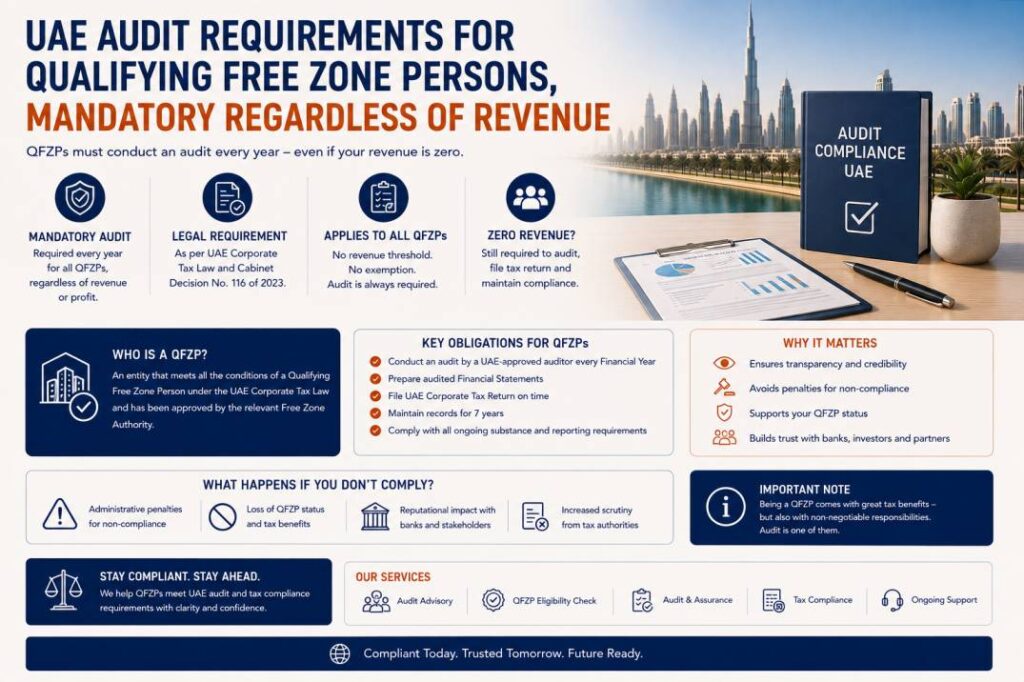
A business that is none of the above, meaning a standalone taxable person under AED 50 million with no QFZP election and no tax group membership, has no corporate tax audit obligation. That is the group most guides describe as exempt, and it is accurate as far as corporate tax law goes. It says nothing about system two above.
UAE Audit Requirements for Tax Groups: The Rule Everyone Half-States
This is worth its own section because the correct version is stated inconsistently, and the wrong version leads to real, avoidable duplicated cost.
Individual entities within a Tax Group are not required to prepare their own standalone audited financial statements for corporate tax purposes, even where an individual member’s revenue independently exceeds AED 50 million. The audit obligation sits at the group level, delivered through aggregated special purpose financial statements covering the group as a whole, audited by a UAE-licensed auditor.
I have seen this misread in both directions. Some guides state the group-level rule correctly but do not clarify that members are exempt individually, leaving a reader to assume every subsidiary needs its own audit on top of the group’s. Others miss that the group-level requirement now applies regardless of the group’s consolidated revenue, a stricter position than under the earlier decision, where smaller groups had more room.
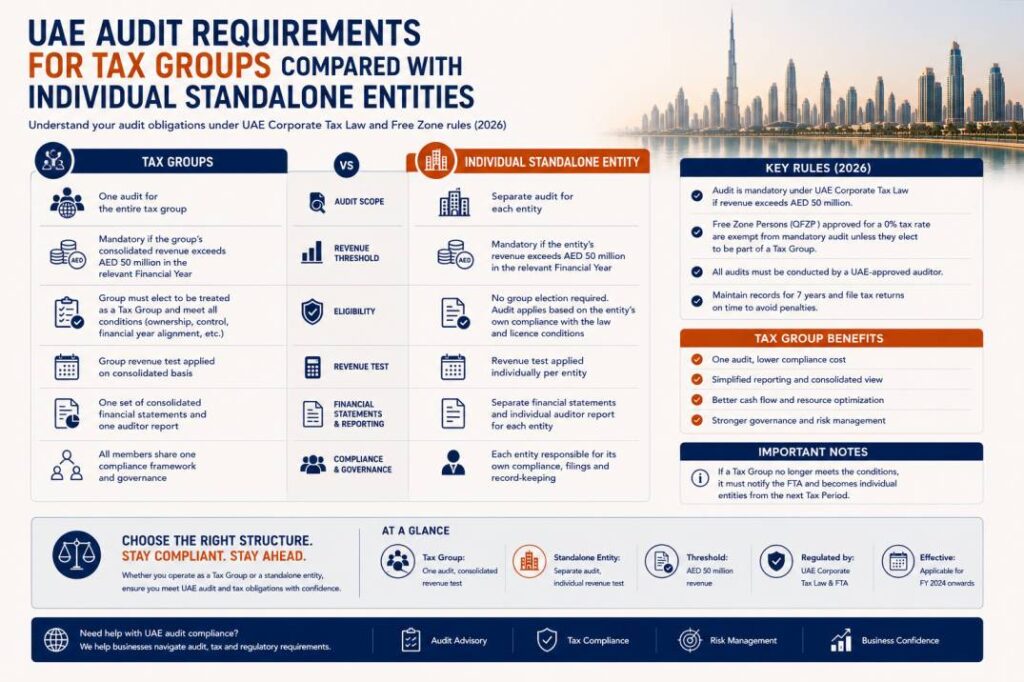
The practical consequence: if you are structuring a tax group, budget for one audit at the aggregated level, not one per member entity, and confirm this explicitly with your auditor rather than assuming either extreme. Subsidiary-level accounting records still need to be prepared consistently with the parent’s policies, since discrepancies in policy application across group members are a recognised source of aggregation errors that draw FTA scrutiny, even though no individual member is separately audited.
The Free Zone and Mainland Licence Trigger Behind UAE Audit Requirements That Nobody Centres
Return to system two, because it deserves more than the single sentence it usually gets.
A licensing authority’s audit requirement is a condition of doing business under that licence, not a tax obligation. It exists because the authority wants assurance about the companies operating under its name, independent of anything the FTA cares about. Some free zones require it annually as a standing renewal condition. Others only request it in specific circumstances, such as a significant change in shareholding or activity. The position varies by authority and is not standardised across the UAE the way the corporate tax rule is.
This matters most for exactly the businesses the corporate tax rule exempts: a small company, well under AED 50 million, with no QFZP election and no tax group membership, correctly believing it has no federal audit obligation, and then discovering at renewal time that its own free zone requires one anyway.
The only reliable way to know is to check your specific licence terms and your free zone or mainland authority’s current renewal requirements directly, since this is not a rule that can be generalised safely across every jurisdiction in the UAE. For the fuller picture on how free zone choice interacts with tax and compliance obligations generally, see best free zones in UAE for AI and technology companies and why Fujairah free zones are a strong setup opportunity for trading.
The AED 50 Million Threshold Behind UAE Audit Requirements Does Double Duty
One connection almost no guide draws: the same AED 50 million figure that triggers the corporate tax audit obligation also determines which accounting standard you are required to use.
Under Ministerial Decision No. 114 of 2023, a taxable person may use IFRS for Small and Medium-sized Entities, a simplified standard, only if revenue does not exceed AED 50 million in the tax period. Above that threshold, full IFRS is required.
Crossing AED 50 million in a single tax period therefore changes two things at once: you move from no mandatory audit to a mandatory one, and you move from a simplified accounting standard to full IFRS. Founders planning for growth past that line should budget for both changes together, not discover the accounting standard requirement separately from the audit requirement months later.
UAE Audit Requirements for Non-Residents: Only UAE-Attributable Revenue Counts
A detail specific to foreign companies operating in the UAE through a branch or another form of taxable presence, and mentioned by very few sources.
For a non-resident taxable person, the AED 50 million threshold is calculated only on revenue attributable to a UAE permanent establishment or nexus, not the company’s global revenue. A foreign company with billions in worldwide revenue but a modest UAE branch generating AED 8 million locally is measured against the AED 8 million, not the global figure, when determining whether the audit obligation applies.
This matters directly for anyone operating a branch of a foreign company in the UAE, where the branch’s UAE-sourced revenue, not the parent’s consolidated position, is what the corporate tax audit rule actually looks at. The full mechanics of branch registration and tax treatment are covered in how to set up a branch of a foreign company in the UAE.
UAE Audit Requirements: What to Actually Do About It
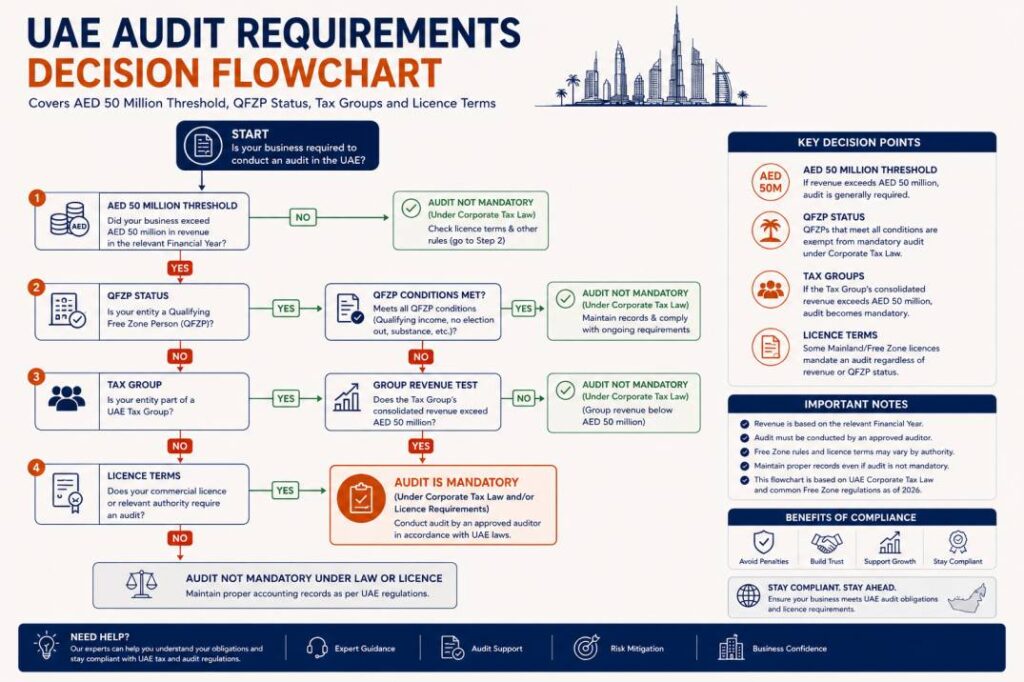
Four checks, in order, rather than relying on a single rule.
Check your revenue against AED 50 million, using UAE-attributable revenue only if you are a non-resident taxable person.
Check whether you hold, or intend to hold, a QFZP election. If yes, the audit obligation applies regardless of the answer to the first question.
Check whether you are part of, or forming, a tax group. If yes, the obligation sits at group level, and individual members do not need their own audit.
Separately, check your licence terms with your specific free zone or mainland authority. This is independent of the three checks above and can require an audit even when corporate tax law does not.
None of these four checks should be done once and forgotten. Revenue changes year to year, QFZP elections can be made or lost, tax group structures change, and licensing authority terms are updated periodically. Treat this as an annual review alongside your renewal, not a one-time classification.
My Approach: Knowing Which UAE Audit Requirement Applies Before It Becomes a Deadline
Most business setup consultants help you register a company. I help you make informed business decisions before you invest.
The founders who get caught out on UAE audit requirements are almost never the ones with an obviously large, complex business. They are the ones who read one guide, confirmed they were under AED 50 million, concluded they had no audit obligation, and never checked their own free zone’s licence terms or considered how a future QFZP election or tax group structure would change the answer. Getting this right at formation, not at renewal, is the difference between an audit being a planned annual cost and an unplanned one.
My advisory process focuses on helping you reduce uncertainty and make confident decisions, not just complete documentation. In practice:
- Structure assessment that checks both systems, corporate tax triggers and your specific licensing authority’s terms, rather than relying on the federal rule alone.
- QFZP election guidance that accounts for the audit obligation it creates from day one, regardless of revenue.
- Tax group structuring, where relevant, planned around the group-level audit requirement rather than assuming per-entity obligations.
- Revenue and IFRS threshold planning, since crossing AED 50 million changes your accounting standard and your audit obligation together.
- Coordination with financial reporting and audit-ready bookkeeping once your specific obligation is confirmed, so the audit itself is straightforward rather than a scramble.
- Corporate tax registration and filing planning that treats the audit question as part of the same conversation, not a separate one.
- Structure and jurisdiction guidance that weighs licensing authority audit terms as a real cost factor, not an afterthought.
The objective is simple: help you start your business with clarity, confidence and a long-term strategy, knowing exactly which audit rule applies to you and why, well before your first renewal or filing deadline.
If you are unsure which of these rules applies to your business, or you are structuring now and want it planned for correctly from the start, get in touch.
Frequently Asked Questions
Does every UAE company need an audit?
No. Under Ministerial Decision No. 84 of 2025, only three categories have a corporate tax audit obligation: standalone taxable persons with revenue over AED 50 million, Qualifying Free Zone Persons regardless of revenue, and tax groups at the aggregated level. Separately, some free zone and mainland licensing authorities require an audit as a condition of licence renewal regardless of tax status.
Do Qualifying Free Zone Persons need an audit even with low revenue?
Yes. Every QFZP must maintain audited financial statements regardless of revenue, because the audit is how the FTA verifies continued eligibility for the 0% corporate tax rate, income segregation and compliance with the de-minimis threshold. A small or pre-revenue QFZP still has this obligation from the point of election.
Do all members of a UAE Tax Group need their own audit?
No. Individual entities within a Tax Group are not required to prepare standalone audited financial statements for corporate tax purposes, even if an individual member’s revenue exceeds AED 50 million. The obligation sits at the group level through aggregated special purpose financial statements, regardless of the group’s consolidated revenue.
If my revenue is under AED 50 million and I am not a QFZP, am I exempt from audit?
You have no audit obligation under corporate tax law in that case. However, your free zone or mainland licensing authority may still require an annual audit as a condition of licence renewal, entirely independent of your corporate tax position. Check your specific licence terms rather than assuming exemption.
How is the AED 50 million threshold calculated for a non-resident company?
Only revenue attributable to a UAE permanent establishment or nexus counts, not the company’s global revenue. A foreign company’s branch generating modest UAE revenue is measured against that UAE-sourced figure alone when determining whether the audit obligation applies.
Does crossing AED 50 million in revenue change anything besides the audit requirement?
Yes. Under Ministerial Decision No. 114 of 2023, businesses may use the simplified IFRS for SMEs standard only below AED 50 million in revenue. Above that threshold, full IFRS is required, so crossing the line changes both your audit obligation and your accounting standard at the same time.
Which authorities are known to require an audit regardless of revenue?
DMCC and JAFZA are commonly cited as free zones requiring audited accounts as a condition of licence renewal, and several mainland structures carry similar conditions in certain emirates. Requirements are not standardised across the UAE, so confirm directly with your specific licensing authority rather than assuming a blanket rule.
Sources & References
- Ministry of Finance – Ministerial Decision No. 84 of 2025 on Audited Financial Statements
- Deloitte Middle East – New Ministerial Decision No. 84 of 2025 issued by the Ministry of Finance
- Federal Tax Authority
- UAE Ministry of Finance – Corporate Tax
UAE audit requirements are more nuanced than the three-line summary most guides repeat, and getting your specific position confirmed is worth doing properly rather than assuming the general rule applies to your free zone entity.