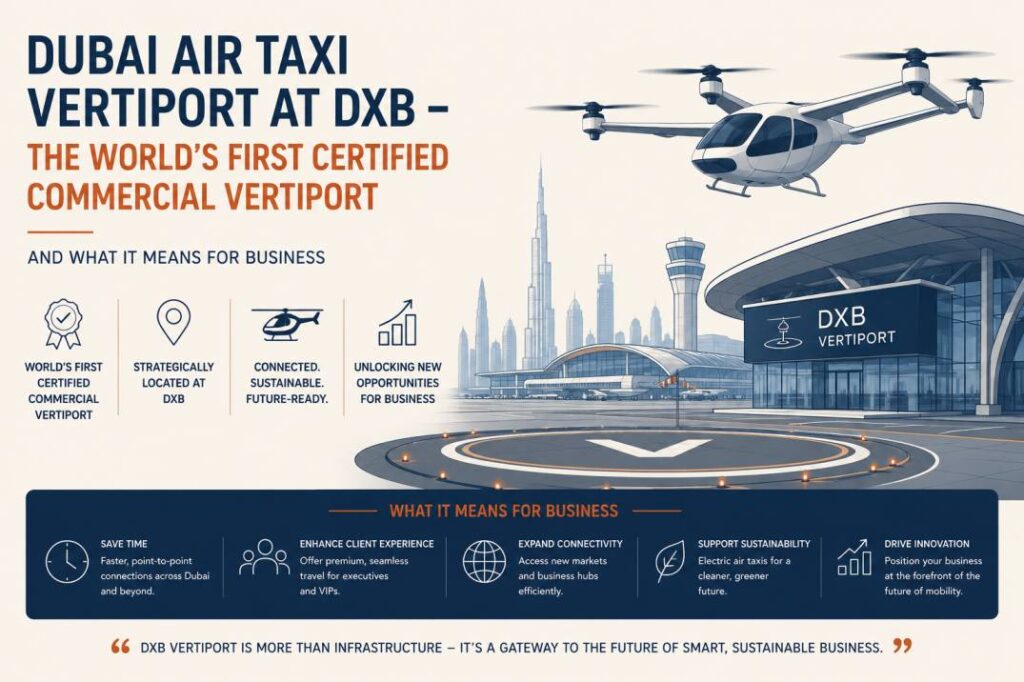
Dubai now has the world’s first fully completed and certified commercial air taxi vertiport. The coverage has been enthusiastic and accurate, and it has almost entirely missed the part that matters if you are a founder rather than a passenger. The right to operate air taxis in Dubai was signed away in February 2024, exclusively, for six years. So the honest question is not whether to start an air taxi company. It is what the Dubai air taxi vertiport actually opens up, and the answer is more interesting than the headline.
Quick Navigation
Quick Answer
- The Dubai International Vertiport (DXV), next to Dubai International Airport, reached technical completion in April 2026 and became the world’s first certified commercial vertiport. Roughly 3,100 square metres, two take-off and landing areas, capacity for 170,000 passengers and 42,000 aircraft movements a year.
- Joby Aviation holds the exclusive right to operate air taxis in Dubai for six years under a definitive agreement with the RTA. Skyports Infrastructure holds exclusive rights to build and operate the vertiports. No competing operator can fly commercial routes in that window.
- Skyports has publicly named aircraft production rate, not infrastructure, as the likely medium-term constraint.
- 170,000 passengers a year is a small number relative to Dubai’s transport volumes. The near-term opportunity is not passenger volume.
- The realistic openings are adjacent: maintenance, ground handling, charging, pilot training, aviation insurance and legal, software, vertiport concessions and cargo.
What the Dubai Air Taxi Vertiport Actually Is
The Dubai air taxi vertiport, formally the Dubai International Vertiport or DXV, sits beside Dubai International Airport. It was developed by Skyports Infrastructure with Dubai’s Roads and Transport Authority, and it is the first facility to receive design approval under the UAE’s new Vertiport Regulations.
The specifics of the Dubai air taxi vertiport, because they are worth having straight:
- Around 3,100 square metres across four floors, combining passenger processing and flight operations in one building
- Two dedicated take-off and landing areas
- Capacity for 170,000 passengers and 42,000 aircraft movements a year
- Joby’s Global Electric Aviation Charging System, the first fast-charging equipment ever fitted at a commercial vertiport
- A hybrid regulatory framework developed with the General Civil Aviation Authority, allowing the site to handle conventional helicopter traffic as well as eVTOL
- Direct access to the Emirates Metro Station and an integrated multistorey car park
The timeline ran fast. Groundbreaking in the fourth quarter of 2024, topping out at 60% completion during the Dubai Airshow in November 2025, technical completion showcased on 17 April 2026, certification following in July. Crown Prince Sheikh Hamdan bin Mohammed reviewed the completed station in April and directed that the service launch for public use before the end of the year.
The aircraft is the Joby S4, carrying a pilot and four passengers at up to 200 miles per hour, roughly 320 km/h, with a range around 160 kilometres. In November 2025 Joby flew the UAE’s first point-to-point crewed eVTOL flight, a 17-minute journey from its Margham test site to Al Maktoum International Airport.
Further vertiports are in development at Palm Jumeirah, Dubai Marina and Downtown, with sites also announced at the American University of Dubai, Atlantis The Royal and the Dubai Mall.
That is the news, and it is genuinely impressive. Now the part the news leaves out.
The Exclusivity Nobody Puts in the Headline
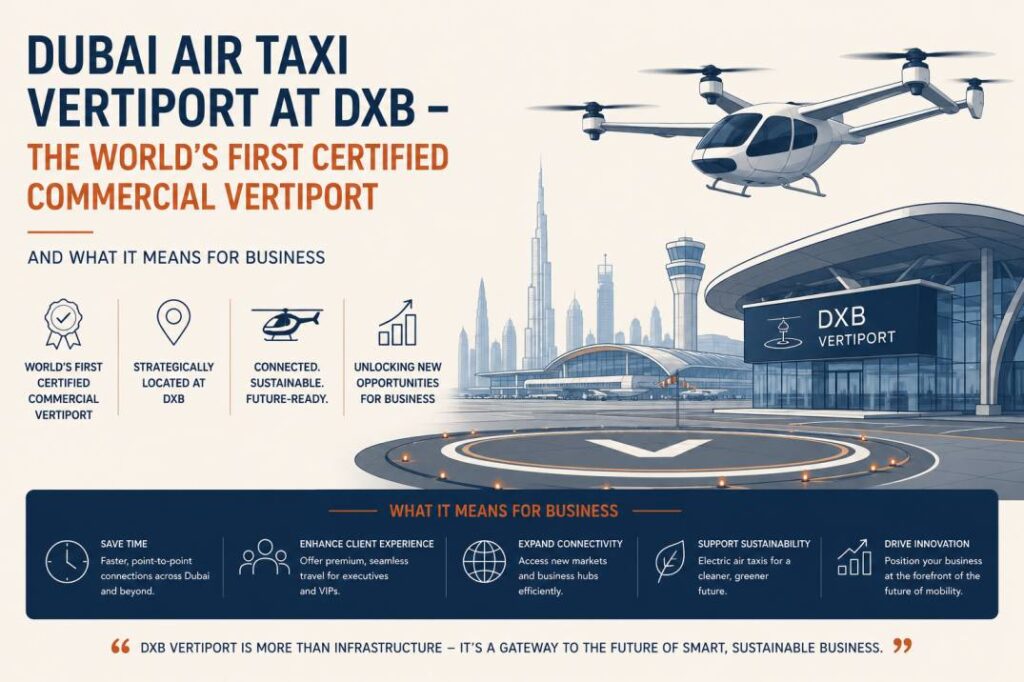
The Dubai air taxi vertiport was never going to be an open market. In February 2024, at the World Governments Summit, Joby Aviation signed a definitive agreement with the RTA. That agreement grants Joby the exclusive right to operate air taxis in Dubai for six years.
Skyports signed separately, and holds exclusive rights to build and operate vertiports in Dubai.
Read those two sentences again if you were planning to enter this market. Both the flying and the infrastructure are spoken for. During the exclusivity window, no competing operator can fly commercial air taxi routes in Dubai, and no other developer is building vertiports there.
This is not hidden. It appears in Joby’s own press releases and in the RTA announcements. But it is treated as a detail about the deal rather than what it actually is, which is a closed door on the two most obvious businesses in the sector.
I raise it because the predictable reaction to a story like this is a founder thinking about an air taxi startup, or a vertiport development play. Both are unavailable in Dubai for now, and finding that out after you have paid for a feasibility study is an expensive way to learn it.
The productive response is not disappointment. It is to look at what an exclusive operator with a fleet, a network of vertiports and a hard launch deadline is going to need to buy from somebody.
The Constraint Is Aircraft, and Skyports Said So
One line in the coverage is worth more than the rest of it combined, and it came from Skyports’ own Director of Infrastructure, speaking to Zag Daily: while infrastructure and aircraft development are progressing well, a potential barrier in the medium term is the rate of aircraft production.
That is the infrastructure builder saying the Dubai air taxi vertiport is ready and the aircraft may not keep up.
Two things follow.
Network expansion will outpace fleet expansion. Vertiports are construction projects with known timelines. Certified aircraft are a manufacturing and regulatory problem, and Joby is producing them for multiple markets at once. Expect the vertiport network to be capable of more than the fleet can serve for some time.
Anything that increases utilisation of a scarce fleet has value. If aircraft are the constraint, then turnaround time, charging speed, maintenance downtime and scheduling efficiency all become commercially significant rather than operational details. That is a useful lens for anyone looking at where to build.
The Number That Reframes the Whole Story
The Dubai air taxi vertiport is designed for 170,000 passengers a year at full utilisation.
Hold that against Dubai’s other transport volumes. Dubai International Airport handles tens of millions of passengers annually. The Metro carries hundreds of millions of riders a year. Against that, 170,000 is a rounding error.
This is not a criticism of the project. A flagship first node is supposed to be small, and the number is a design capacity rather than a forecast. But it does mean one thing clearly.
In the near term this is not a volume business. Anyone building a revenue model on air taxi passenger numbers at launch is building on a very small base. Reported early pricing estimates put trips somewhere in the range of premium chauffeur service, which tells you the target customer is a small, high-value segment, not mass transit.
The commercial significance of the Dubai air taxi vertiport in its first years is not the passengers moving through it. It is that Dubai now has a certified, operating, regulator-approved template for advanced air mobility that no other city has. The exportable asset is the framework, not the ticket sales.
If your business case depends on air taxi volume before 2030, be honest with yourself about the arithmetic. If your business case depends on Dubai being first and setting the standard, that is a much stronger footing.
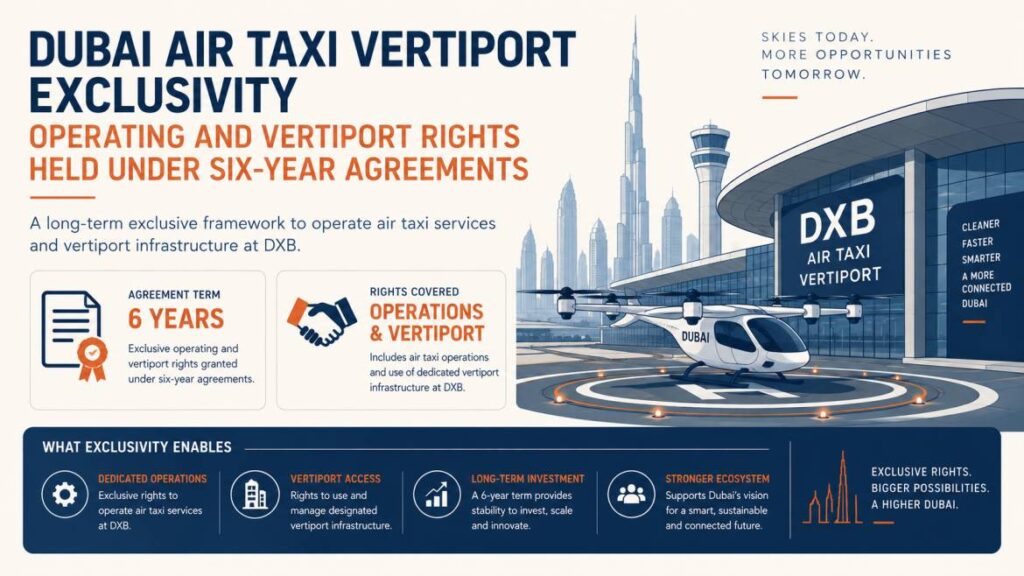
Dubai Air Taxi Vertiport: Where the Real Opportunities Are
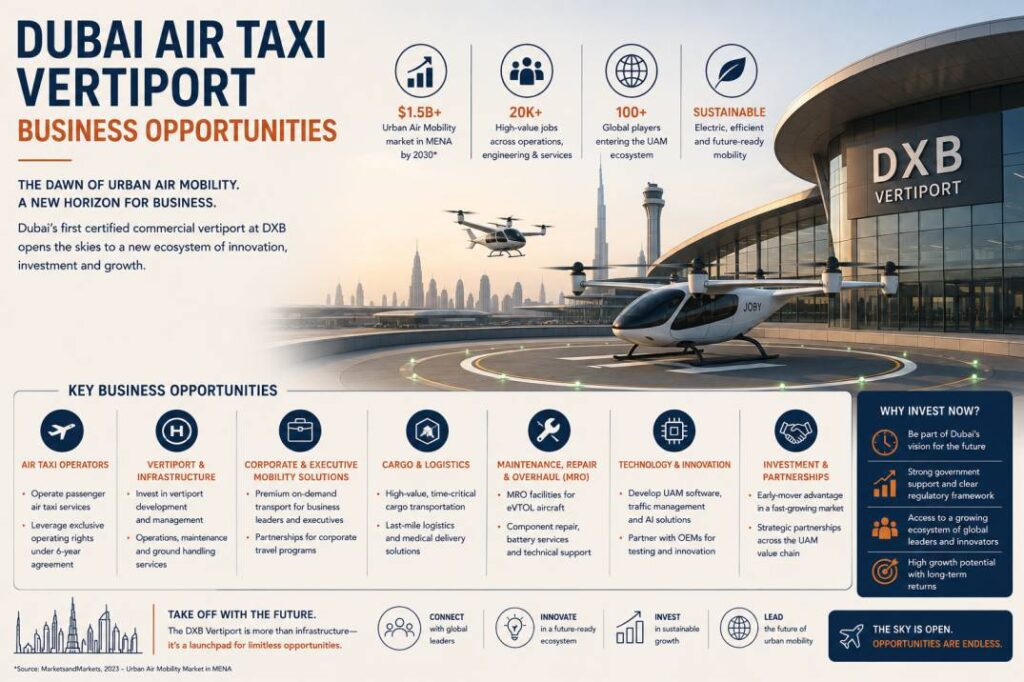
The Dubai air taxi vertiport network gives an exclusive operator a growing footprint and a government deadline, which creates demand it cannot satisfy in-house. Eight places where a business can participate without needing an operating licence.
Maintenance and repair. Every certified aircraft needs a maintenance regime. eVTOL introduces requirements conventional aviation MRO does not cover, particularly around battery health and electric propulsion. This is a specialist, licensable, defensible business.
Ground handling and vertiport operations support. Passenger processing, baggage, security coordination, turnaround. Skyports operates the vertiports; it does not necessarily perform every function inside them.
Charging infrastructure and energy. The vertiport uses Joby’s own charging system, but as the network expands to Palm Jumeirah, Marina, Downtown and beyond, the electrical supply, grid connection and energy management behind those sites is a genuine engineering market.
Pilot training and crew supply. The S4 is piloted. A network of vertiports needs a pipeline of type-rated pilots, and the region does not have one yet.
Aviation insurance, legal and compliance. A new aircraft category, a new regulatory framework and a new liability profile. Specialist advisory demand runs ahead of the flights.
Software and integration. Booking, scheduling, fleet utilisation, integration with ground transport and hotel systems. If aircraft are the constraint, the software that maximises their use is valuable.
Vertiport concessions. A four-storey building processing premium passengers has retail, food and beverage, and lounge potential, the same way an airport terminal does.
Cargo and logistics. The exclusivity covers air taxis. Drone and cargo applications sit in a different segment, and Dubai’s logistics infrastructure is already built for it. Worth reading alongside the Dubai South logistics corridor, which is where much of the aviation cluster actually sits.
The pattern is the one that holds in most new sectors: the licensed operator captures the headline and the suppliers capture the early margin.
What Licence Any of This Would Need
Any business serving the Dubai air taxi vertiport needs two layers of permission, and people routinely miss the second.
A commercial licence from an emirate authority or a free zone. That gets you incorporated and lets you trade.
Sector approval from the General Civil Aviation Authority where your activity touches aircraft, airworthiness, crew or air operations. Maintenance, training and anything airside falls here. A trade licence naming an aviation activity does not by itself authorise you to perform regulated aviation work, in the same way a fintech trade licence does not authorise you to handle client money.
Where you sit matters too. Dubai’s aviation ecosystem is concentrated around Dubai South and the airport free zones, and proximity to the cluster is worth more in this sector than a marginally cheaper licence elsewhere. The trade-offs between structures are set out in mainland vs free zone vs offshore in the UAE.
If your model is pure software or advisory and never touches an aircraft, you may need no aviation approval at all, which makes it the fastest route in. That is worth establishing before you design the company, not after.
The Property Angle Worth Watching
A short section on what the Dubai air taxi vertiport network might mean for property, because it is speculative and I would rather flag it than oversell it.
Vertiports are being placed at Palm Jumeirah, Dubai Marina, Downtown and Atlantis The Royal. Those are already prime locations, so nobody should expect a vertiport to create value where none existed.
But a ten-minute connection to the airport is a genuine amenity, and amenity changes tend to show up in premium residential and hospitality pricing before they show up in transport statistics. If you track Dubai property, the vertiport locations are a list worth having. Current market data is in the Dubai real estate H1 2026 analysis.
Treat that as a thing to watch rather than a thesis to trade on. The passenger numbers are too small at this stage to move a property market on their own.
My Approach: What I Would Tell You Before You Build a Deck
Most business setup consultants help you register a company. I help you make informed business decisions before you invest.
If you came to me with an air taxi business idea after reading about the Dubai air taxi vertiport, the first conversation would be short and would probably disappoint you: the operating rights and the vertiport rights are both exclusive and both taken. The useful conversation starts immediately afterwards, when we look at what the exclusive operator and the exclusive infrastructure developer are going to need to buy over the next six years, and whether you can credibly supply any of it.
That is the difference between a sector being closed and a sector being crowded. This one is closed at the top and wide open underneath.
My advisory process focuses on helping you reduce uncertainty and make confident decisions, not just complete documentation. For a founder looking at this sector:
- Market reality check first, including the exclusivity position and the actual volumes, before anything is modelled.
- Segment selection across maintenance, ground handling, energy, training, software and cargo, matched to what you can actually deliver.
- Regulatory perimeter assessment, establishing whether your activity needs GCAA approval or only a commercial licence.
- Competitor and incumbent mapping, including who already holds the contracts you would be bidding for.
- Financial feasibility built on realistic near-term volumes rather than 2035 projections.
- Structure and jurisdiction selection, weighted toward proximity to the aviation cluster.
- Business setup and licensing execution once the model is sound.
- Corporate tax registration and filing planning appropriate to the activity.
- Visa planning for the specialist technical staff this sector requires.
The objective is simple: help you start your business with clarity, confidence and a long-term strategy.
Is This the Right Sector for Your Business?
Serving the Dubai air taxi vertiport is a good fit if you already have aviation, engineering, energy or specialist software capability and you are looking for a market where that capability is scarce. Dubai has a certified vertiport, a funded operator and a government deadline, which is a rare combination, and the supplier base is thin.
It is a poor fit if the appeal is that air taxis are exciting. Excitement is not a moat, the operating rights are gone, and the passenger volumes at launch will not support a business that needs scale quickly.
The broader picture on which Dubai sectors are actually performing is in top performing businesses in Dubai 2026.
If you want your specific idea tested against the exclusivity position and the real volumes before you spend anything, get in touch.
Frequently Asked Questions
When will Dubai’s air taxi service actually launch?
Dubai’s Crown Prince directed in April 2026 that the service launch for public use before the end of the year, and the RTA has consistently pointed to a 2026 commercial launch. The vertiport is complete and certified, so the remaining variables are aircraft delivery and final operational approvals rather than infrastructure.
Can I start an air taxi company in Dubai?
No, not during the current exclusivity period. Joby Aviation holds the exclusive right to operate air taxis in Dubai for six years under its definitive agreement with the RTA, signed in February 2024. Skyports separately holds exclusive rights to build and operate vertiports in Dubai.
Where is the Dubai air taxi vertiport located?
The Dubai International Vertiport (DXV) is beside Dubai International Airport, with direct access to the Emirates Metro Station and an integrated multistorey car park. Further vertiports are in development at Palm Jumeirah, Dubai Marina and Downtown.
How many passengers can the Dubai air taxi vertiport handle?
It is designed for up to 170,000 passengers and 42,000 aircraft movements a year at full utilisation. For context, that is a small figure relative to Dubai’s other transport volumes, which is why the near-term commercial significance lies in the regulatory template rather than passenger numbers.
What aircraft will fly from it?
The Joby S4, a piloted all-electric vertical take-off and landing aircraft carrying a pilot and four passengers at speeds up to 200 miles per hour, with a range of roughly 160 kilometres. The vertiport can also handle conventional helicopters under a hybrid framework agreed with the GCAA.
What business opportunities does the vertiport create?
Adjacent supply rather than operations: aircraft maintenance and repair, ground handling, charging and energy infrastructure, pilot training, aviation insurance and legal advisory, scheduling and booking software, vertiport retail concessions, and cargo or drone logistics, which sits outside the air taxi exclusivity.
Do I need aviation approval to serve this sector?
It depends on the activity. A commercial licence from an emirate authority or free zone lets you incorporate and trade. Anything touching aircraft, airworthiness, crew or air operations also requires approval from the General Civil Aviation Authority. Pure software or advisory businesses that never touch an aircraft may need no aviation approval at all.
Sources & References
- Skyports Infrastructure – World’s first commercial vertiport reaches technical completion
- Joby Aviation – Dubai air taxi network and vertiport locations
- Joby Aviation – Definitive agreement with Dubai’s RTA
- Dubai Roads and Transport Authority
- UAE General Civil Aviation Authority
The Dubai air taxi vertiport itself is not the opportunity, what it signals about the surrounding advanced-mobility ecosystem is. Founders who understand that distinction can position around the Dubai air taxi vertiport story instead of just reading about it.