UAE GDP Q1 2026 grew 3% year-on-year, driven by a 17.3% spike in financial services – here is what the numbers actually say.
Quick Answer
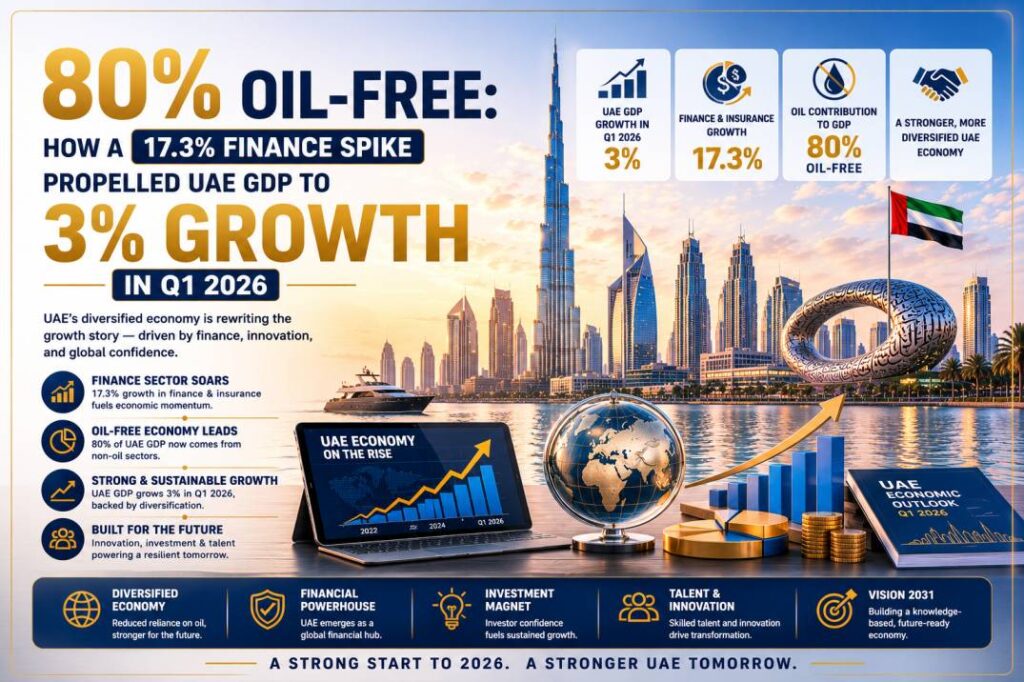
- UAE GDP grew 3% year-on-year in Q1 2026, driven by a 17.3% spike in financial services specifically, not broad-based growth across all sectors.
- The non-oil economy now accounts for roughly 79.4% of GDP, reinforcing the diversification trend, though the headline figure understates how concentrated the growth driver actually is.
- Several sectors are growing alongside finance, and understanding which ones matters more than the headline growth number for anyone weighing a UAE market entry.
- A strong GDP print does not automatically mean every sector or business model is well-timed; the structural detail behind the number matters more than the number itself.
In this guide
The numbers released by the Federal Competitiveness and Statistics Centre on 4 August 2026 say more than they appear to at first glance. The UAE’s real GDP grew 3% year-on-year in Q1 2026, reaching AED 485 billion at constant prices – while non-oil GDP expanded by 4.8%, pushing its share of the national economy to 79.4%. For anyone planning to do business in the UAE, that 79.4% figure is the one that matters most.
The UAE earned its reputation as an oil-dependent economy. That era is, for all practical purposes, over.
The Sector That Did the Heavy Lifting
Not all sectors grew equally, and this is where the story gets strategically interesting. Financial and insurance activities led every sector, growing 17.3% year-on-year and contributing 2.44 percentage points to headline GDP growth – the single largest contribution of any sector in the economy.
To put that in plain terms: finance was not just growing – it was pulling the rest of the economy forward. Construction followed at 8.1% growth. Human health and social work expanded 7.7%. Information and communications grew 5.9%. Professional, scientific and technical activities combined with administrative and support services rose 4.9%. Real estate climbed 4.8%, public administration rose 4.5%, and wholesale and retail trade grew 2.6%.
This is broad-based growth, not a single-sector anomaly. But the finance spike is the headline because it confirms something that advisors and investors have been watching build since 2022: the UAE’s financial infrastructure is maturing into a structural engine, not a cyclical beneficiary.
What “Regional Challenges” Means for Your Business Plans
The official data carries a notable phrase: the figures reflect the UAE’s resilience despite regional challenges during the first quarter, whose impact was confined to a limited number of activities and did not affect the overall trajectory of economic growth. The underlying point is important. If you were weighing up a UAE market entry during early 2026 and paused because of regional uncertainty, the macroeconomic data suggests that hesitation cost you a quarter of momentum in a market that did not slow down.
This is not an argument for ignoring geopolitical risk – that is a real factor in any business plan. It is an argument for building your scenario analysis properly, rather than making binary go/no-go decisions based on headlines.
Why the Non-Oil Share Matters Beyond the Headline
The contribution of non-oil activities to UAE GDP increased from 78.0% in 2025 to 79.4% in Q1 2026 – a 1.4 percentage point shift in a single quarter. Compounded over several years, this is the structural story. The UAE’s “We the UAE 2031” Vision targets doubling the economy to AED 3 trillion by 2031, and the non-oil trajectory is tracking ahead of where it needs to be to get there.
For an entrepreneur or investor looking at the UAE, this matters in a specific way: it means the government’s economic policy is oriented toward the sectors you are most likely to operate in. Finance, trade, technology, health, professional services – these are not afterthoughts. They are the policy priority. The licensing environment, the free zone infrastructure, the CEPA trade network, the DIFC’s growth to over 10,000 registered companies – all of it is pointed at this same goal.
Dr Thani bin Ahmed Al Zeyoudi, Minister of Foreign Trade, linked the performance to expanding trade ties, noting that non-oil exports grew 23.9% in the first half of 2026 to reach AED 452.8 billion, supported by the UAE’s network of Comprehensive Economic Partnership Agreements.
That 23.9% non-oil export growth is the trade complement to the domestic finance boom. If you are a manufacturer, a services exporter, or a distributor using the UAE as a re-export hub, the CEPA network is the most underused lever in the market. Most of the 37 CEPAs the UAE has concluded are still not being operationalised by the companies that could benefit from them, because qualifying on origin and documentation is more complex than most business setup consultants will tell you upfront.
What This Means If You Are Considering a UAE Market Entry
Every quarter that the non-oil economy outgrows the oil sector makes the UAE a more commercially stable jurisdiction to operate in. A market growing at 3% overall with a 17.3% finance spike and 23.9% non-oil export growth is a market with legitimate momentum – not a market in recovery mode, and not a market propped up by commodity prices.
The practical question is not whether the UAE economy is growing. It clearly is. The practical question is which structure gives your business the right to participate in that growth – and what it actually costs and qualifies you for.
Most business setup consultants help you register a company. I help you make informed business decisions before you invest.
That distinction matters here more than ever, because the Q1 2026 data tells you the UAE’s finance and services sectors are expanding – but it does not tell you whether your specific business model qualifies for the free zone tax regime you are being sold, whether the activity you want to conduct is permitted in the jurisdiction you are looking at, or whether the banking relationship you need is actually accessible at your stage and your structure.
Before you choose between a mainland company formation, a free zone structure, or an offshore holding vehicle, the conversation needs to start with what you are trying to achieve commercially – your revenue model, your customer base, where you will invoice from, and whether your activity is a Qualifying Activity under the UAE’s corporate tax framework if you intend to benefit from the 0% free zone rate.
The 17.3% finance sector growth is partly a story about DIFC and ADGM continuing to attract sophisticated capital. But it is also a story about ordinary businesses banking better, structuring better, and accessing financial services that were harder to access a few years ago. That requires getting your UAE corporate bank account set up through the right structure, with the right documentation, at the right time in your setup sequence – not as an afterthought.
The Sectors Growing Alongside Finance
A few of the other growth figures deserve attention from an operational standpoint.
Construction at 8.1% is partly a reflection of infrastructure investment – airport expansion at Al Maktoum, data centre buildout, and the continued delivery of residential and commercial supply in Dubai and Abu Dhabi. For businesses in materials, contracting, MEP, or fit-out, this signals sustained demand.
Information and communications at 5.9% aligns with what the UAE’s AI and digital infrastructure pipeline suggests – the US–UAE AI chip deal and the broader digital economy investment are beginning to show up in the economic baseline, not just in announced plans.
Real estate at 4.8% confirms that the UAE real estate market remains a live sector despite what some bearish commentary suggested after transaction volumes moderated from the record H1 2025 pace. The underlying demand from population growth and business formation is still there.
Wholesale and retail trade at 2.6% is the most modest figure in the group – and arguably the most honest signal about what the regional uncertainty actually affected. Consumers and traders are more cautious than constructors and financiers. That said, 2.6% growth in a quarter that included genuine disruption is not a contraction – it is a plateau.
My Approach to Reading This Data
When I research the UAE economy for clients or for this Insights series, I cross-reference official data – in this case from the Federal Competitiveness and Statistics Centre – against on-the-ground regulatory reality and the specific cost structures different business models will encounter.
A 17.3% finance sector growth rate is a genuine signal. But it does not mean every financial services business model will thrive in the UAE, or that setting up in DIFC is affordable for an early-stage firm (it often is not). It means the ecosystem is deepening, which tends to benefit businesses that have done the structural groundwork properly.
The questions worth asking now are: which sectors intersect with your business model? What does your business structure decision need to look like to participate in that growth legitimately, not just nominally? And have you factored in UAE corporate tax registration from day one of your setup, or is that still being treated as a Year 2 problem?
If you are at the stage where those questions matter, start with a strategy conversation, not with a licence quote.
Frequently Asked Questions
What drove UAE GDP growth in Q1 2026?
Non-oil sectors led the expansion, with financial and insurance activities recording 17.3% growth and contributing more to headline GDP than any other sector. Non-oil GDP as a whole grew 4.8%.
What percentage of UAE GDP is now non-oil?
As of Q1 2026, non-oil activities account for 79.4% of UAE GDP, up from 78.0% in 2025.
Does UAE GDP growth mean it is a good time to set up a business there?
Sustained non-oil growth signals a maturing market with genuine commercial depth. However, timing a market entry is only one part of the decision. The right structure, the right jurisdiction, and the right activity classification all matter as much as macro conditions.
Which UAE free zone is best for a finance or financial services business?
DIFC and ADGM are the primary regulated financial centre options. DIFC now has over 10,000 registered companies and is internationally recognised. However, not all financial activities can be licensed there, and cost structures differ significantly from mainland or standard free zone setups. The right answer depends entirely on the regulated activity, the target client base, and the capital available.
How does UAE corporate tax affect businesses in the non-oil growth sectors?
Businesses operating on the mainland are subject to 9% corporate tax on taxable income above AED 375,000. Free zone businesses can access a 0% rate on qualifying income only – but the definition of qualifying income, and the annual compliance requirements introduced by FTA Decision No. 6 of 2026, make this more complex than most promotional material suggests.
Related reading: the UAE defence industry’s AED-scale economic footprint.
Related reading: why Blackstone returned to DIFC and what it signals.
Related reading: the UAE’s $3 trillion sovereign wealth footprint.
Sources & References
Which sectors are actually hiring behind this growth
A GDP growth figure this broad tends to mask which sectors are genuinely adding headcount versus which are simply reporting higher output from existing teams. The financial services growth behind this quarter’s numbers has translated into real hiring demand, particularly for compliance, risk and regulatory roles as institutions scale their UAE operations to match the sector’s expansion, rather than growth being purely a function of asset values rising.
Non-oil sectors more broadly are following a similar pattern, where growth is showing up as genuine operational expansion rather than paper gains. That distinction matters for anyone reading this data as a market-entry signal, since a sector adding real jobs and real office space is a more durable indicator of sustained demand than one where growth is concentrated in valuation increases alone.
For a founder deciding where to position a new business, this means looking past the headline growth rate and checking which specific sub-sector within financial services, or within the broader non-oil economy, is showing matching increases in office leasing, hiring activity and new business licensing. Growth concentrated in one narrow segment is a different opportunity from growth spread broadly across an industry, and the structuring decision often depends on which of the two you are actually entering.
Reading a single quarter’s growth figure critically
One quarter of strong GDP data is informative, but it is not, by itself, proof of a sustained trend. Quarterly national accounts figures are frequently revised as more complete data comes in, and a first estimate can move meaningfully by the time the final figure is published months later. Treating a single quarter’s headline number as a settled fact, rather than an early read subject to revision, is a common mistake in coverage of this kind of data.
The more useful signal is whether the growth composition holds up across consecutive quarters: does the non-oil share of the economy keep expanding, does financial sector output keep contributing at a similar rate, and does hiring data in the relevant sectors continue tracking the reported growth. A founder making a market-entry decision based on this data is better served by checking the next one or two quarterly releases against this one than by treating a single strong quarter as the entire investment case.
None of this argues against acting on the current data. It argues for building a modest margin of caution into any plan based on it, and for checking the next release before treating this quarter’s number as a permanent feature of the market rather than one strong data point in an ongoing series.
Treat this quarter’s figures as a strong opening data point rather than a finished story, and revisit the underlying sector data each time a new release lands before committing further capital on the strength of the headline growth rate alone.
The businesses that benefit most from macro tailwinds like this one are rarely the ones that reacted fastest to the headline, but the ones that had already built a structure ready to scale once the demand showed up.
What UAE GDP Q1 2026 means for founders and investors
UAE GDP Q1 2026 growth of 3% is the headline, but the composition matters more than the rate. UAE GDP Q1 2026 data shows financial services as the fastest-growing sector at 17.3% – which means the demand environment for B2B financial services, fintech, advisory and professional services is genuinely strong. For a founder deciding whether to enter the UAE market in 2026, UAE GDP Q1 2026 provides the clearest structural signal we have had in several years: non-oil diversification is working, and the growth is coming from sectors where independent advisory and specialist services can compete.