Fujairah free zone company setup keeps coming up in trading conversations for good reason: the geography is real, the costs are below Dubai, and the tax position is genuinely achievable – with conditions that most published material does not explain accurately.
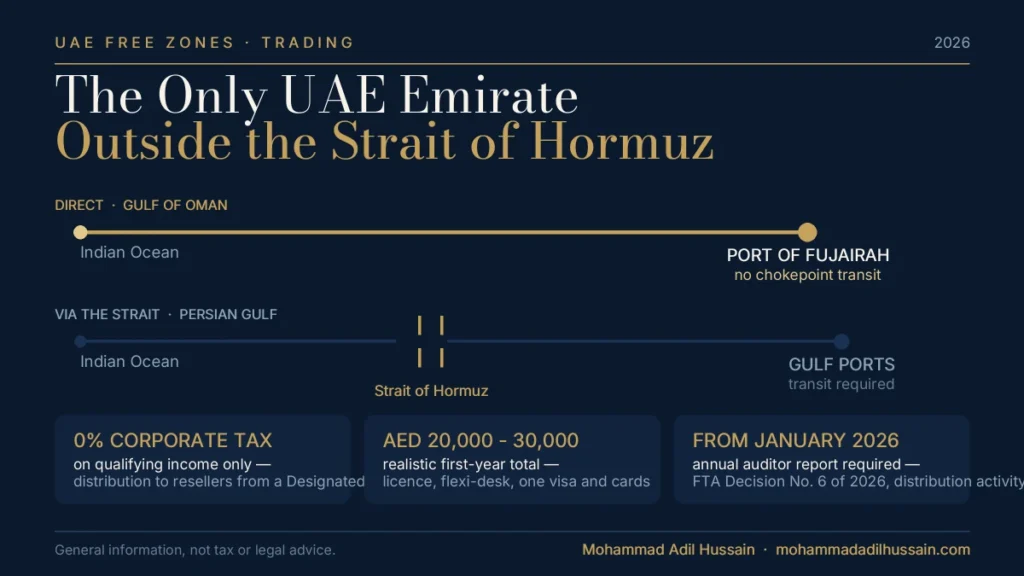
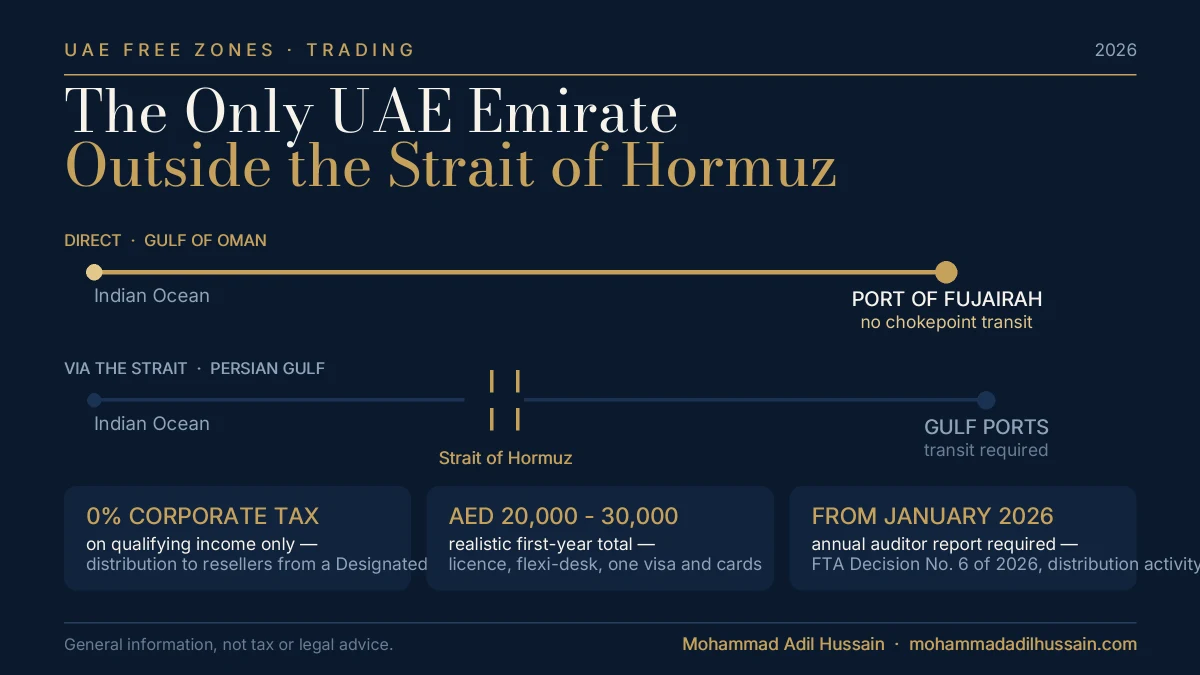 Fujairah keeps coming up in trading conversations this year, and the geography behind it is real: it is the only emirate sitting entirely on the Gulf of Oman, outside the Strait of Hormuz.
The pitch you will see circulating goes roughly like this – bypass Hormuz, pay 0% customs, pay 0% corporate tax, set it all up remotely for around AED 12,000.
Three of those four claims need conditions attached. One of them changed in June 2026 and most of the material online has not caught up. Here is what actually applies to a genuine Fujairah free zone company setup in 2026.
Quick Answer
- Fujairah’s geographic advantage is real: direct Indian Ocean access avoids the Strait of Hormuz transit that Persian Gulf ports require.
- A 0% corporate tax position is genuinely achievable for a Fujairah free zone trading company, but only under specific qualifying conditions, not automatically.
- Something changed in June 2026, and a meaningful share of published material online has not caught up with the current position.
- 0% customs savings are real but conditional, and the right free zone, FFZA or FOIZ, depends on the specific type of trading activity.
- Remote setup is genuinely possible, with realistic costs below equivalent Dubai options.
In this guide
Why are traders looking at Fujairah in the first place?
A Fujairah free zone company setup is drawing more attention from traders every quarter, and the reason is geographic before it is fiscal.
Because it is the only UAE emirate located entirely on the Gulf of Oman, giving direct Indian Ocean access without transiting the Strait of Hormuz.
That is not marketing. For a trader moving physical goods, it removes a chokepoint from the route map, and chokepoint risk prices into marine insurance and transit schedules.
The supporting infrastructure is genuine too. The Port of Fujairah is one of the world’s largest bunkering hubs – ranked second or third globally depending on the year and the measure used – with a container terminal operated by Abu Dhabi Ports and an oil storage complex serving traders across the region. Fujairah International Airport and road links into Oman and the wider GCC round out sea, air and land access from one base.
Cost is the other genuine advantage. Fujairah packages consistently undercut Dubai equivalents, and warehousing and industrial land are materially cheaper per square metre than JAFZA or KEZAD.
So the location case holds. The tax case is where the published material gets loose.
Does a Fujairah free zone licence give my trading company 0% corporate tax?
Not automatically. Trading income only reaches 0% if it qualifies as distribution in or from a Designated Zone and the buyer is a reseller or processor – selling to end users is taxed at 9%.
This is the single most misrepresented point in UAE free zone marketing, so it is worth being precise.
A free zone company pays 0% only on Qualifying Income, and only while it holds Qualifying Free Zone Person status. For a trading business, the relevant Qualifying Activity is the distribution of goods or materials in or from a Designated Zone. The conditions attached to it are specific:
- Your customer cannot be the end user. They must resell the goods, or process or alter them for onward sale. Supplies to a public benefit entity also qualify following Ministerial Decision No. 229 of 2025, which replaced MD 265 of 2023 and applies retroactively from 1 June 2023.
- You must verify that. Due diligence on customers – trade licence checks, signed reseller declarations, contractual representations – is an expectation, not a nicety.
- Goods sold to UAE customers outside a Designated Zone must physically enter the Designated Zone. A paper trail through the zone is not the same as goods moving through it.
- The AED 375,000 band does not help you. A QFZP pays 9% on non-qualifying income from the first dirham. The small-profit relief that mainland companies rely on does not extend to it.
- Failure is a five-year event. Breach a single QFZP condition and the company is taxed at 9% on all income for that period and the four that follow.
If you are still weighing structures at a higher level, I compared the three routes in mainland vs free zone vs offshore.
What changed in June 2026?
The FTA now requires free zone distributors to obtain an independent auditor’s report each year to keep the 0% rate.
FTA Decision No. 6 of 2026, issued on 2 June 2026, applies to tax periods beginning on or after 1 January 2026. Any QFZP relying on the distribution activity must obtain an Independent Agreed-Upon Procedures report from an external auditor, testing a sample of customers and imports to confirm two things: that buyers are genuinely resellers, and that imported goods entered the UAE through the Designated Zone.
It does not change the tax rate. It changes what you must prove to keep it – and it adds an annual audit cost that almost no cost comparison currently includes. If your model depends on the 0% rate, budget for this from year one and keep reseller declarations, sale agreements, delivery notes and import records as you go. Reconstructing them at audit is where businesses come unstuck. This sits alongside your ordinary corporate tax registration and filing obligations, not instead of them.
Are the 0% customs savings real?
Yes for goods that stay in the zone or are re-exported – but duty is suspended, not cancelled, and 5% applies the moment goods enter the UAE mainland.
Fujairah Free Zone and the Fujairah Oil Industry Zone both hold Designated Zone status under Cabinet Decision No. 59 of 2017, which treats them as outside the UAE for VAT on qualifying movements of goods. Combined with customs treatment, that makes genuine transshipment and re-export models efficient.
Two qualifications worth holding onto:
- Designated Zone status covers goods, not services. Services supplied inside the zone follow normal UAE VAT rules.
- Zone brand names do not map neatly onto the Cabinet Decision geography. Verify your specific licensed premises against the current list rather than relying on the free zone’s marketing name. This catches people out more often than you would expect.
FFZA or FOIZ – which zone do I actually need?
FFZA for general trading and commercial activity; FOIZ only if you are in oil, gas, bunkering or marine energy.
Material discussing “Fujairah Free Zone” frequently blends the two, and they are not interchangeable. The Fujairah Free Zone Authority handles import, export, distribution and wholesale trading of physical goods, plus professional and service licences. The Fujairah Oil Industry Zone sits adjacent to the oil storage complex and is built for petroleum, petrochemicals, bunkering, marine services and energy logistics, with licence costs to match.
One more piece of history that causes confusion: IFZA was originally established in Fujairah in 2018, then relocated to Dubai Silicon Oasis in 2020. An IFZA licence today is a Dubai licence. If your reason for choosing Fujairah is the Hormuz bypass, IFZA does not deliver it.
What does it actually cost?
Budgeting for a Fujairah free zone company setup means separating the headline licence fee from the real first-year total.
Trading licences start around AED 12,000 to AED 20,000 a year, but a realistic first-year total including flexi-desk, one visa and cards lands closer to AED 20,000 to AED 30,000.
The licence fee is the number that gets advertised. The number that matters is the total cost of being operational, which also carries annual audited financial statements – mandatory for QFZP status, not optional – and, from 2026, the AUP report if you are claiming the distribution activity.
Treat all published figures as indicative and get a current written quote before committing. Package pricing moves, and capital and facility requirements vary by licence type. Warehousing and land remain the genuine saving against Dubai and Abu Dhabi.
Can I set the company up remotely?
You can incorporate remotely. You cannot hold the 0% rate remotely.
Incorporation, document submission and licensing can all be completed digitally from abroad, and that is a real convenience. But QFZP status requires adequate substance: core income-generating activities performed in the zone, adequate physical assets, qualified full-time employees and adequate operating expenditure.
That condition exists specifically to filter out licence-only structures. A company with a Fujairah licence, no premises and no people in the zone may be perfectly legal – it simply will not sustain the tax position the licence was bought for. This is also the point at which corporate bank account opening becomes difficult; banks apply their own substance tests, and trading entities face enhanced due diligence.
So is Fujairah the right choice?
A Fujairah free zone company setup is not the right move for everyone. For the right model, it is a strong one. A genuine transshipment or re-export operation, moving physical goods to resellers, with real warehousing and people on the ground, gets a defensible tax position, a Hormuz-free route and a cost base well below Dubai.
For a trader selling to UAE end customers, or running a licence with no physical footprint, the advantages largely evaporate – and a mainland licence at 9% with unrestricted market access may be the better structure, honestly assessed.
Most enquiries I receive ask which free zone is cheapest. A better question is: where do my goods physically move, who is my buyer, and does my model actually meet the qualifying conditions? Answer that first and the jurisdiction usually selects itself. Answer it second and you pay to restructure.
Most consultants will help you register the company. I help you make informed business decisions before you invest – which sometimes means telling you the zone you asked about is the wrong one. If you are weighing a UAE trading structure, free zone formation and wider setup advisory both start from the same place.
Because successful businesses aren’t built by chance – they’re built on informed decisions.
Planning a trading or logistics operation in the UAE? Let’s start with strategy, not paperwork.
My Approach: Matching the Zone to the Trade
Most business setup consultants help you register a company. I help you make informed business decisions before you invest.
Fujairah’s trading advantages are real, but which zone and structure fit depends entirely on your specific cargo, customer base, and whether the 0% customs treatment actually applies to your goods. Before recommending FFZA, FOIZ or a different zone entirely, I check your product classification and trade route against what each zone actually offers.
My advisory process focuses on helping you reduce uncertainty and make confident decisions, not just complete documentation.
What You Can Expect
- Business idea validation
- Market research
- Competitor analysis
- Business plan development
- Startup cost estimation
- Financial feasibility analysis
- Business structure recommendations
- Licence selection guidance
- Investor and employment visa planning
- Business bank account strategy
- Risk assessment
- Business expansion planning
The objective is simple: help you start your business with clarity, confidence and a long-term strategy.
Frequently asked questions
Is Fujairah Free Zone a Designated Zone for VAT?
Yes. Fujairah Free Zone and the Fujairah Oil Industry Zone are both listed under Cabinet Decision No. 59 of 2017, meaning qualifying movements of goods are treated as outside the UAE for VAT. The status applies to goods, not services, and you should verify your specific licensed premises against the current list rather than the zone brand name.
Do free zone trading companies pay 0% corporate tax in the UAE?
Only on qualifying income. For traders that means distribution in or from a Designated Zone to a reseller, processor or public benefit entity. Sales to end users are taxed at 9%, and a Qualifying Free Zone Person does not receive the AED 375,000 small-profit band on non-qualifying income.
What is FTA Decision No. 6 of 2026?
It requires Qualifying Free Zone Persons carrying out distribution in or from a Designated Zone to obtain an annual Independent Agreed-Upon Procedures report from an external auditor, for tax periods beginning on or after 1 January 2026. The auditor tests a sample of customers to confirm they are resellers, and verifies that imported goods entered the UAE through the Designated Zone.
How much does a Fujairah free zone trading licence cost in 2026?
Trading licences start at roughly AED 12,000 to AED 20,000 annually, with a realistic first-year total of AED 20,000 to AED 30,000 once a flexi-desk, one visa and cards are included. Annual audited financial statements are mandatory for QFZP status, and distribution activities now carry an additional audit report cost.
Last reviewed: 27 July 2026. General information, not tax or legal advice. Free zone rules, qualifying activity lists and licence pricing change frequently – verify against the FTA, the Ministry of Finance and the relevant free zone authority before acting.
How a Fujairah free zone company setup compares to the alternatives
Founders weighing Fujairah rarely compare it against nothing. The realistic alternatives are usually Sharjah, RAK or a Dubai free zone, and the comparison is worth making honestly rather than assuming Fujairah wins on cost alone.
On setup cost, Fujairah and RAK sit close together, and both are typically cheaper than the equivalent Dubai licence once office and visa costs are included. Sharjah often prices in between the two. The gap that matters more than the headline licence fee is logistics: warehousing rates, port access charges, and how far the goods have to travel to reach a customer or a vessel. A slightly cheaper licence in a zone with weaker port connectivity can end up costing more once freight and transit time are priced in.
Banking is the other practical differentiator. Fujairah-registered companies can open accounts with UAE banks the same way any other free zone entity does, but a bank’s comfort with a specific free zone’s reputation and documentation standards can still affect how quickly an account gets approved. Building a clean, complete company file from day one, rather than treating compliance as an afterthought, tends to matter more for account approval speed than which zone is on the licence.
Timing the move matters too. Applying before a peak shipping season, rather than during one, generally means faster processing on licence issuance and warehouse allocation, since free zone authorities and freight forwarders alike are less stretched outside those windows.
Whichever route you take into Fujairah, getting the activity code, zone and banking documentation right at the outset saves far more time than it costs, and it is the part most guides skip in favour of the headline tax rate.
A short call before committing to either FFZA or FOIZ, to confirm your exact activity against the zone’s current fee schedule, tends to be worth more than any amount of general reading.
Sources & References
- Fujairah Free Zone Authority
- UAE Federal Tax Authority – Designated Zones
- UAE Ministry of Finance – Qualifying Income
Further reading: Trading vehicle parts rather than general goods? I covered whether an automotive spare parts trading business in Dubai makes sense, with real setup costs and break-even figures.
Pingback: Blackstone DIFC 2026: What the Move Signals for Dubai
Pingback: UAE Sovereign Wealth 2026: The Funds, Ranking and Opportunity