Quick Answer
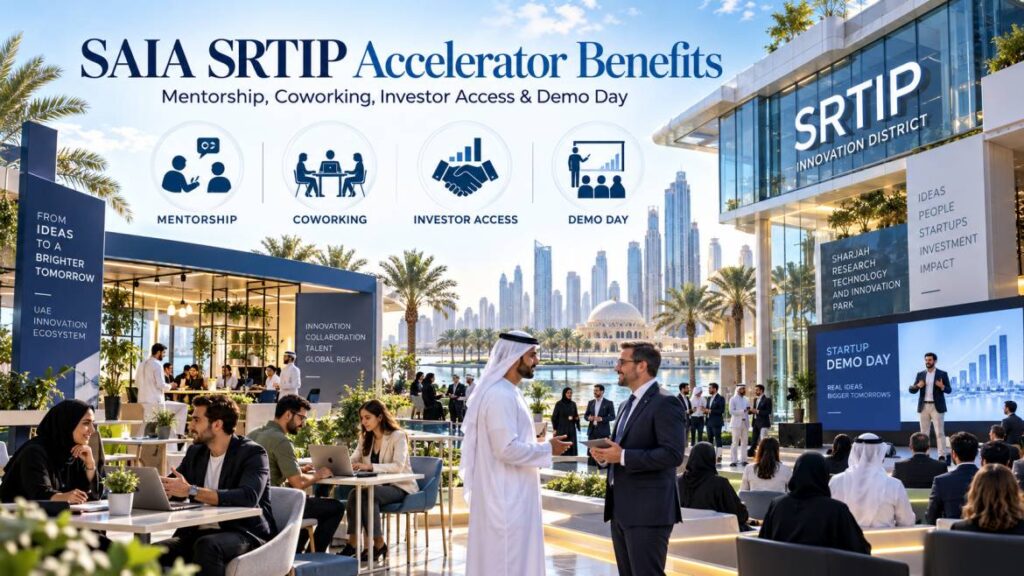
The SAIA SRTIP accelerator, formally the Sharjah Advanced Industry Accelerator, is SRTIP’s cohort-based startup programme, not a business licence. It offers a time-limited programme (recent cohorts have run roughly ten weeks, including an on-campus intensive) built around mentorship from 200+ industry partners, discounted coworking at SPark, direct introductions to corporates, government bodies and Business Angel networks, and a demo day where finalists pitch for a grand prize that has run up to US$50,000. The one thing founders consistently get wrong: getting into the SAIA SRTIP accelerator is not the same as forming a licensed company under SPARK (formerly SRTIP), and understanding that difference before you apply saves real time and money.
Table of Contents
What the SAIA SRTIP Accelerator Actually Is, and What It Isn’t
The SAIA SRTIP accelerator is SRTIP’s flagship programme, run as competitive, time-boxed cohorts rather than an ongoing service. Past editions have opened applications over several months, shortlisted around 25 to 30 startups, selected up to 10 per cohort, and run an on-campus acceleration phase of roughly two weeks before a public demo and investor day. It’s a programme you apply to and get selected for, not a licence category, and not the same thing as SRTIP Accelerator, the older brand name that’s now simply called SPARK, the free zone itself. That naming overlap is exactly where confusion creeps in, and it’s worth being precise about it before applying to either.
What SAIA Offers Selected Startups
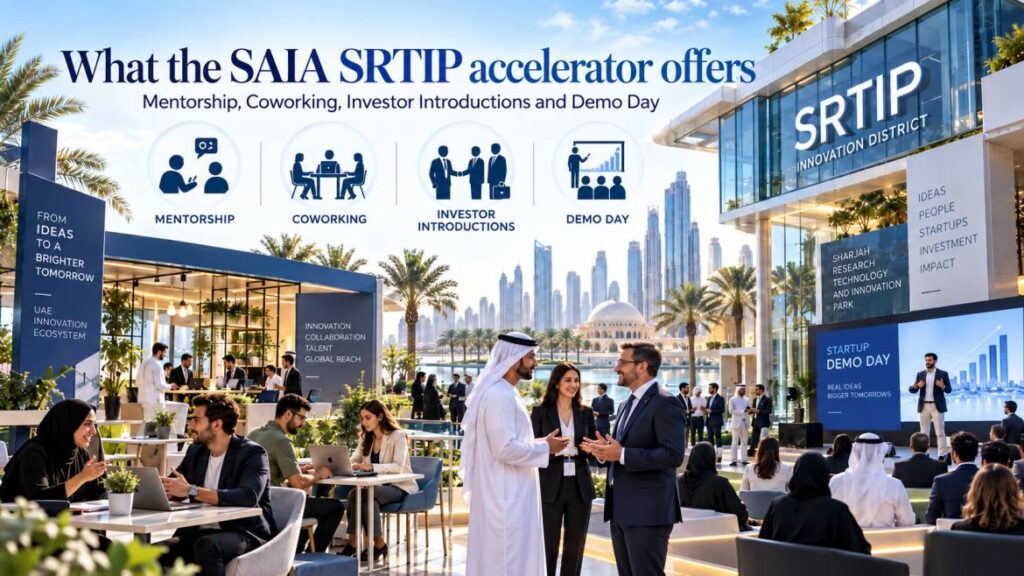
Based on SRTIP’s own published SAIA programme page, a cohort place typically includes:
- Free access to the accelerator programme itself, with no participation fee for selected startups.
- Discounted coworking and office space at SPark for the duration of the cohort.
- Advisory and mentorship from a stated network of 200-plus industry partners.
- Direct client connections and marketing visibility through SRTIP’s corporate and government network.
- Access to an additive manufacturing and rapid prototyping hub for hardware-adjacent startups.
- Introductions to Business Angel networks and, in some cohorts, a grand prize that has reached US$50,000.
- A public demo day where finalists pitch to investors, corporates and the wider ecosystem.
None of this is guaranteed funding. It’s structured access, mentorship and visibility, and the actual capital, if any, depends on investor interest generated on the day, not a fixed grant every participant receives.
Who Actually Fits a SAIA Cohort
SAIA has generally targeted growth-stage, technology-driven companies rather than pure idea-stage founders, with priority sectors that map closely onto SRTIP’s own target industries: waste management and circularity, precision agriculture, healthcare technology and hospital automation, insurtech, and smart materials or advanced manufacturing. Cohort themes shift year to year, so the exact sector list is worth confirming against the current SAIA call for applications rather than a prior year’s, but the overlap with SRTIP’s broader sector strategy is consistent. If your business sits in one of these areas, it’s worth reading the sector-specific regulatory picture as well as the accelerator opportunity: SRTIP for sustainability and environmental technology for waste management and circularity, and SRTIP for healthcare, medtech and insurtech for healthcare technology and insurtech.
The Company-Formation Question SAIA Doesn’t Answer
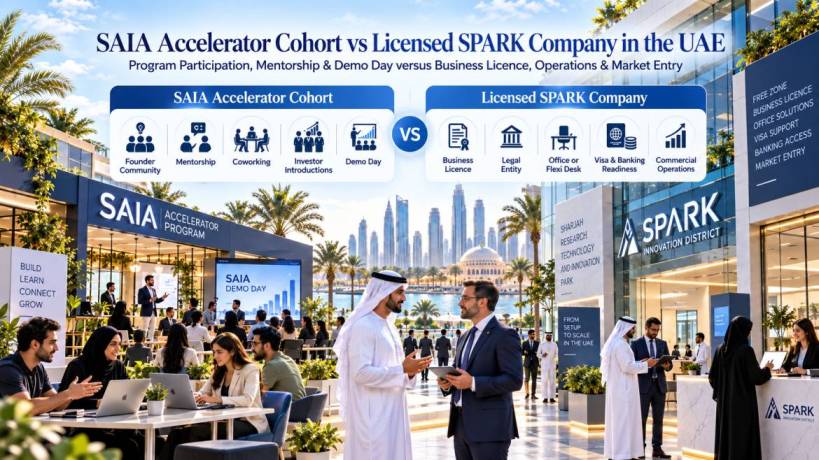
This is the part general SAIA overviews skip. Being accepted into SAIA is a cohort placement, it isn’t a company licence, and it doesn’t automatically register your business in the UAE. Two practical questions follow from that, and both are worth settling before you apply, not after you’re selected:
- Do you need a licensed UAE entity to participate? Requirements vary by cohort, some accept founders operating from an overseas entity for the programme itself, but any funding, client contract, or ongoing UAE presence generally needs an actual SPARK company formed alongside or after the accelerator, not instead of it.
- What happens after demo day? The visibility and investor introductions SAIA generates are only useful if the business is structured to actually receive investment, sign a UAE client, or open a bank account when the opportunity appears, which means the licence, activity scope and Qualifying Free Zone Person tax position should be thought through in parallel with the accelerator application, not scrambled together afterward.
None of this makes SAIA the wrong opportunity, it’s a genuinely useful accelerator for the right stage and sector of business. It means the accelerator and the company formation are two separate tracks that need coordinating, and treating SAIA selection as the finish line rather than the midpoint is where founders lose momentum right after the demo day visibility they worked for.
The Tax Point If SAIA Leads to UAE Revenue
A free zone company doesn’t automatically pay 0% corporate tax, only a Qualifying Free Zone Person receives 0% on Qualifying Income, covered in full in UAE Corporate Tax Registration & VAT Filing. If a SAIA demo day connection turns into a UAE client contract or investment, the resulting revenue mix needs assessing against Qualifying Income rules before assuming the free zone name alone covers it.
Opening a Business Bank Account After SAIA
No provider or free zone can guarantee bank account approval, that decision sits entirely with the bank’s own compliance process, covered further in Banking & Financial Services. A founder who has just raised investor interest at a SAIA demo day should expect banks to ask for the same documentation any early-stage company needs, formation papers, activity scope and a clear source of incoming funds, so having that ready before the follow-up conversations start speeds the process considerably.
My Approach: Beyond the Accelerator
Most SAIA overviews stop at the programme benefits. The part that actually determines whether the accelerator translates into a real business is the formation track running alongside it, the licence, the activity scope, and the Qualifying Income position, so that a strong demo day doesn’t stall out waiting for paperwork. I work through both halves with founders: whether SAIA fits the business stage and sector at all, and what the SPARK company formation needs to look like so investor interest or a UAE client contract can actually be acted on when it appears.
This sits alongside the sector-specific guidance I’ve written across SRTIP’s target industries: for research and innovation projects in SRTIP for research and innovation projects, for mobility and logistics digitisation in SRTIP for mobility and logistics digitisation, for sustainability and environmental technology in SRTIP for sustainability and environmental technology, for healthcare, medtech and insurtech in SRTIP for healthcare, medtech and insurtech, and for e-commerce technology founders specifically in my take on SRTIP Accelerator for e-commerce founders. The fuller case for working this way is in why founders choose to work with me.
If you’re considering applying to SAIA and want a straight read on whether it fits your stage and sector, and what to have ready on the formation side before demo day, get in touch.
Frequently Asked Questions
Is the SAIA SRTIP accelerator the same as forming a company under SPARK?
No. The SAIA SRTIP accelerator is a competitive cohort programme. Forming a licensed company is a separate process under SPARK, SRTIP’s current brand name, and the two need coordinating rather than assumed as one step.
Does SAIA guarantee funding to every selected startup?
No. Selected startups get structured mentorship, coworking, visibility and investor introductions, including a demo day. Actual investment depends on investor interest generated on the day, not a fixed grant.
What stage of company does SAIA typically accept?
Past cohorts have generally targeted growth-stage, technology-driven companies rather than pure idea-stage founders, though the exact bar shifts by cohort and should be checked against the current call for applications.
Which sectors does SAIA usually prioritise?
Recent cohorts have emphasised waste management and circularity, precision agriculture, healthcare technology and hospital automation, insurtech, and smart materials or advanced manufacturing, though themes shift year to year.
Do I need a UAE company before applying to SAIA?
Requirements vary by cohort. Some accept founders operating from an overseas entity for the programme itself, but any ongoing UAE presence, client contract or funding generally needs an actual SPARK company formed alongside or after the accelerator.
What should I have ready if a SAIA demo day leads to investor interest or a UAE client?
A clear licence and activity scope, a Qualifying Free Zone Person tax position assessed against your actual revenue mix, and the formation documentation a bank will ask for before you can actually receive funds.
Is SRTIP Accelerator the same thing as SAIA?
No, and this is the most common mix-up. SRTIP Accelerator is an older brand name for the free zone itself, now called SPARK. SAIA is a specific startup accelerator programme SRTIP runs within that free zone.