The SRTIP SPARK Sharjah free zone story starts with a name change: Sharjah’s Research, Technology and Innovation Park rebranded to SPARK in October 2025. Nearly a year later, almost every guide to this free zone, including a section already on this site, still calls it SRTIP. The name change is the most immediately checkable fact about it, and it isn’t even the most interesting one. Official sector data confirms that digitalization, AI, IoT, Big Data and smart city applications, is the largest single category by registered company count: 52 of 105 companies. A free zone built and marketed around six research sectors in equal standing has, in practice, become something closer to an AI free zone with five smaller categories attached. Here is what SPARK actually is, what changed, and what choosing it actually involves in 2026.
Quick Navigation
Quick Answer
- SRTIP officially rebranded to SPARK in October 2025, confirmed by named quotes from its CEO and Director of Strategic Communications. Most current guides, and searches, still use the old name.
- Digitalization is confirmed as SPARK’s largest sector by registered company count: 52 of 105 companies, ahead of water management, renewable energy, environmental technology, advanced manufacturing and smart manufacturing combined.
- SPARK offers dual licensing, operating in both the free zone and Sharjah mainland simultaneously, but this requires an NOC from the free zone, not an automatic feature.
- As of 10 September 2026, the official SPARK Starter package starts at AED 3,999 for zero visas, rising to AED 10,990 with one visa, a limited-time offer that has replaced the older AED 5,500 pricing still shown on several third-party guides. Corporate tax registration is not included in the Starter tier; it is included from the Growth tier upward.
- Dedicated research labs covering technology, health and substance research are available, priced separately from workspace packages.
- SPARK is not automatically tax-free. Free zone companies fall within UAE Corporate Tax as Taxable Persons; only a Qualifying Free Zone Person receives 0% on Qualifying Income, and registration is still required regardless.
SRTIP SPARK Sharjah Free Zone: The Rebrand Nobody’s Caught Up With
Start here, since it’s the fact every other guide to the SRTIP SPARK Sharjah free zone story is currently missing.
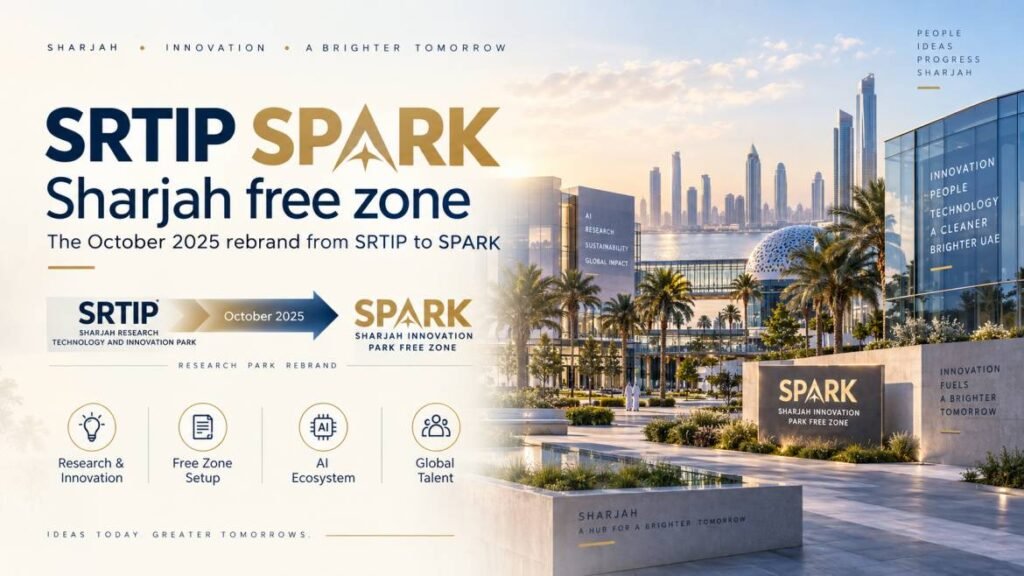
In October 2025, the Sharjah Research, Technology and Innovation Park announced a full corporate identity refresh, adopting SPARK as its unified official name. This wasn’t an informal nickname or a marketing shorthand; it came with named, on-record quotes from Hussain Al Mahmoudi, CEO, and Juma Al Haj, Director of Strategic Communications and Marketing, published through Sharjah24 and Zawya, two established regional business news outlets. The stated reason was specific: the previous abbreviation, SRTI Park, was frequently mispronounced or confused, and the rebrand was framed as unifying communication with local and international partners under one name.
Nearly a year later, this has barely registered. Checking the actual pages currently ranking for SRTIP setup searches confirms it directly: eight results surface, and every third-party one, including guides published as recently as January and May 2026, still calls it SRTIP. Only SRTIP’s own official website consistently uses “SPark” in its own navigation and content. Its LinkedIn presence has also been updated to the new name. The wider content ecosystem describing this free zone, including a section already published on this site, has simply not caught up. If you’re researching this zone, expect to see both names used interchangeably for some time yet, and know that SPARK is the current, correct one.
SRTIP SPARK Sharjah Free Zone: The Number That Shows What It Actually Became
This is the part of the SRTIP SPARK Sharjah free zone story that goes beyond the name change into what it has actually turned into.
SPARK licenses activity across six research-focused sectors: water management, renewable energy, environmental technology, advanced manufacturing (including transport and logistics technology), digitalization, and smart manufacturing, alongside general commercial, service and non-profit categories. Official materials present these six sectors as parallel pillars of the same innovation mandate.
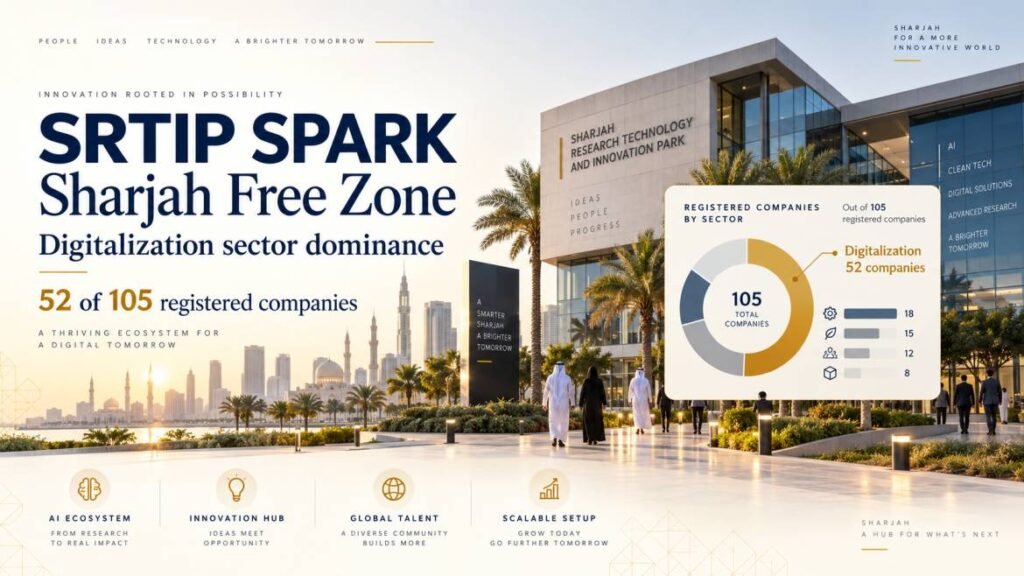
The registered company data tells a different story. Digitalization, covering AI, IoT, Big Data and smart city applications, is confirmed as the largest sector by a wide margin: 52 of 105 registered companies. That means roughly half of everything happening inside SPARK falls under this one category, with the other five sectors splitting the remaining half between them. A free zone marketed around a broad, six-way research mandate has, in practical terms, become substantially an AI and digital technology hub with a smaller, genuinely diverse research tail attached.
This matters directly for how you should read SPARK’s positioning. If your business is AI, software, IoT or smart-city technology, you would be joining the zone’s actual center of gravity, surrounded by more peer companies and, plausibly, more of the zone’s practical attention and infrastructure investment. If your business sits in one of the other five sectors, SPARK’s research mandate still applies to you, but you would be a smaller part of a more concentrated ecosystem than the six-sector marketing suggests.
The Practical Basics Most Guides Bury
A few concrete SRTIP SPARK Sharjah free zone operational facts worth stating plainly before the more distinctive detail.
Anyone comparing the SRTIP SPARK Sharjah free zone against other options should know setup is handled through a fully digital portal, with no need to be physically present in Sharjah to complete registration, and typical processing runs 7 to 10 working days. SPARK supports 1,500-plus approved business activities, spanning commercial, trading, consultancy, services and advanced manufacturing, alongside its core research sectors. Two structures are available: a Free Zone Establishment (FZE) for a single owner, and a Free Zone Company (FZC) for two or more shareholders. The zone sits roughly 4km from Sharjah International Airport and 20km from Dubai International Airport, a genuinely practical detail for a business planning regular international travel.
One SRTIP SPARK Sharjah free zone number worth treating with real caution: some sources describe SPARK’s wider ecosystem as supporting “over 10,000 startups, SMEs and innovation programmes.” This is a different measurement entirely from the 52-of-105 registered-company sector breakdown above, and the two should never be combined into one claim. The 10,000-plus figure most plausibly reflects Sharjah’s broader innovation and SME support programming, while the 105-company figure is the specific, sector-classified count of SPARK-licensed companies. Treat them as answering different questions, not as the same ecosystem measured twice.
Dual Licensing: What It Actually Requires
For anyone comparing the SRTIP SPARK Sharjah free zone against other options, this feature gets mentioned constantly and explained rarely, and the gap matters.
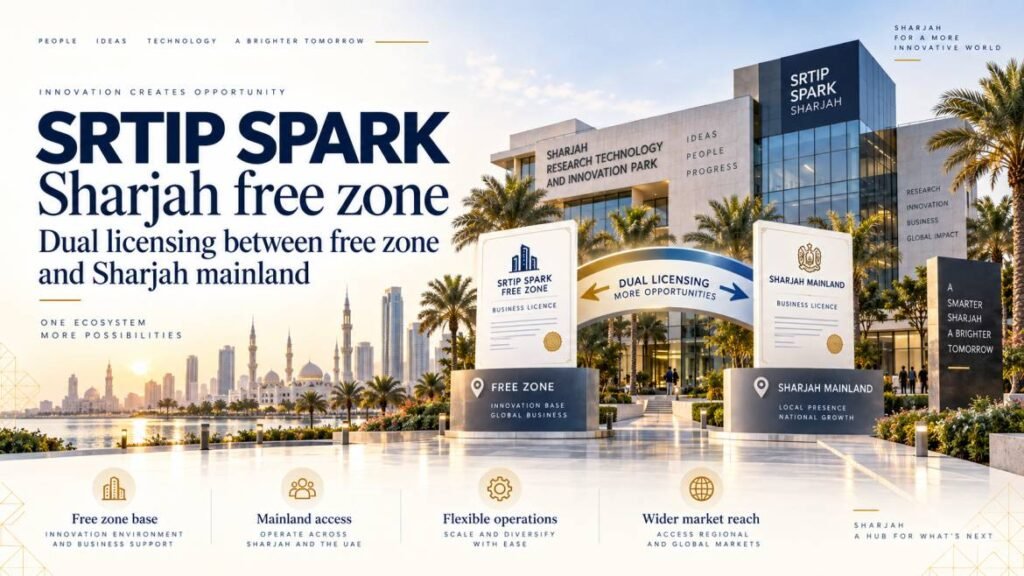
SPARK offers a genuine, distinctive capability: a company can hold licences allowing it to operate in both the free zone and the Sharjah mainland simultaneously. This is a meaningful structural advantage in a market where free zone companies typically face real restrictions on direct mainland trading, a distinction covered in depth in mainland vs free zone vs offshore in the UAE.
What most coverage leaves out: this requires a No Objection Certificate (NOC) from the free zone. It is not an automatic dual status granted at setup. Treat this as a genuine, valuable option worth planning for from day one if mainland access matters to your business model, not as a same-day feature you can add without lead time or paperwork.
What a Package Actually Costs in 2026, and What Changed
Pricing checked directly against the official SPARK page on 10 September 2026. This is the single fastest-moving fact about this free zone, and it is worth stating precisely rather than repeating a figure that may already be out of date by the time you read it.
As of that date, SPARK advertises three package tiers, each available with zero, one or two visas:
| Package | Zero visas | One visa | Two visas |
|---|---|---|---|
| SPARK Starter | AED 3,999 | AED 10,990 | AED 14,695 |
| SPARK Growth | AED 6,499 | AED 14,010 | AED 17,400 |
| SPARK Elite | AED 8,499 | AED 16,010 | AED 19,400 |
SPARK itself describes the Starter pricing above as a limited-time offer. This is exactly why the number above should not be treated as a permanent statutory fee: confirm current availability, inclusions and, critically, the renewal price after the first promotional year, before committing.
What Each Tier Actually Includes
The zero-visa Starter tier currently covers one shareholder, up to three activities, the licence and lease agreement, co-working access, a tax consultation, event and webinar access, and bank account opening assistance. Corporate tax registration and bookkeeping are not included at this tier. Growth raises capacity to up to five shareholders and five activities, and adds corporate tax registration to the package. Elite adds limited bookkeeping, currently described as up to 25 transactions per year, on top of everything Growth includes.
This makes “which package is cheapest” a less useful question than “which package actually contains the shareholder capacity, activities, visas and compliance support your business needs.” A Starter package that excludes tax registration is not necessarily cheaper once you add that requirement back in separately.
Why You May Still See AED 5,500 Quoted Elsewhere
For the SRTIP SPARK Sharjah free zone, that figure was genuine. An official SRTIP guide from August 2025 listed AED 5,500 for a zero-visa option, with AED 13,990 and AED 17,795 for one- and two-visa packages. The zone has since moved to the lower, limited-time SPARK Starter structure above. Several current third-party guides, including some updated within the past month, still display the older AED 5,500 to 6,510 range, which is worth knowing if you are comparing quotes against what you read elsewhere.
Whatever you are quoted, ask for it itemised: licence and registration, lease or workspace, shareholder and activity allowance, visa and immigration processing, medical and Emirates ID costs, tax registration and accounting scope, and the renewal price after any promotional first year.
Is SPARK Really Tax-Free? Not Automatically.
For the SRTIP SPARK Sharjah free zone specifically, this is one of the most important distinctions to understand, and one that marketing language across the free zone sector, including some of SPARK’s own promotional copy, tends to blur.
The UAE Ministry of Finance states that juridical persons established in a UAE free zone fall within the scope of Corporate Tax as Taxable Persons. A Free Zone Person that meets the conditions to become a Qualifying Free Zone Person (QFZP) can receive a 0% Corporate Tax rate on Qualifying Income, a conditional treatment tied to specific activities and income categories, not a blanket exemption that applies automatically to every SPARK company or every type of revenue.
Free Zone Persons still need to register for Corporate Tax. The Ministry requires all Taxable Persons, including Free Zone Persons, to obtain a Corporate Tax Registration Number and generally file a return within nine months of the end of the relevant tax period. The Federal Tax Authority currently warns that late registration can attract an AED 10,000 administrative penalty, subject to the conditions of its penalty-waiver initiative. This is also why, as covered above, the zero-visa Starter package specifically excludes corporate tax registration, and Growth includes it. Do not choose SPARK, or any UAE free zone, on the strength of a “0% corporate tax” headline alone. Assess your actual activities, income categories and economic substance position with a qualified UAE tax professional before relying on QFZP treatment.
What About Economic Substance Regulations?
Older UAE company-formation content can also mislead on this specific point. The Ministry of Finance announced that companies are no longer required to submit ESR notifications or reports for financial years ending after 31 December 2022, following Cabinet Decision No. 98 of 2024. Historical obligations, information requests and penalties tied to earlier periods can still remain relevant, but ongoing annual ESR filing is not a current requirement.
Labs, Funding Access, and the Academic Ecosystem
The parts of the SRTIP SPARK Sharjah free zone offering that go beyond a standard licence.
Dedicated research laboratories, covering technology, health and substance research, are available to SPARK licensees for genuine R&D and testing work, priced separately from workspace packages. This is a real, specific facility offering, not the generic “state-of-the-art infrastructure” language most free zone marketing defaults to.
SPARK is physically anchored inside Sharjah’s University City, positioned within reach of what official materials describe as 150-plus academic institutions, companies and startups. Two more specific figures, a partnership with 22 universities directly and a separate claim of more than 20 higher education institutions, are close enough to each other to be treated as broadly consistent, even though no single source states one authoritative number. The 150-plus figure is best read as the wider University City ecosystem, including companies and startups alongside academic institutions, not a university count on its own. The zone was established in 2016 by royal decree from Sheikh Dr. Sultan Bin Muhammad Al Qasimi, built explicitly on a “triple helix” model: collaboration among academia, industry and government as the founding structure, not an add-on.
Beyond the academic connection, SPARK links to the Sharjah Business Angels Network for early-stage capital access, and hosts the Sharjah Entrepreneurship Festival, a real, if secondary, funding and visibility channel worth knowing about if early-stage capital access factors into your decision.
For anyone weighing the SRTIP SPARK Sharjah free zone, this ecosystem sits inside a genuinely strengthening wider context. The UAE reached 30th place in WIPO’s 2025 Global Innovation Index, its best position to date, and Sharjah specifically attracted AED 7.74 billion in foreign direct investment across 142 projects in 2025, a 45% year-on-year increase in project count from 98 in 2024. That backdrop does not make SPARK the right choice on its own, but it is real, current, independently sourced context for anyone weighing whether Sharjah’s innovation positioning is more than marketing language.
Who SPARK Genuinely Fits
Given everything above, here is the honest fit assessment for the SRTIP SPARK Sharjah free zone.
If you’re building AI, software, IoT, or smart-city technology, SPARK’s actual center of gravity matches your business, and the digitalization sector’s scale, 52 of 105 companies, means you’d be joining an already-substantial peer cluster, not a token category. If you’re in water management, renewable energy, environmental technology, advanced manufacturing or smart manufacturing, the research mandate and lab access still genuinely apply, though you’d sit in a proportionally smaller part of the ecosystem. If direct mainland trading access matters to your model, the dual-licensing route is a genuine differentiator worth planning around, provided you build the NOC requirement into your timeline rather than assuming it’s automatic.
SPARK is a genuinely weaker fit when the decision comes down to finding the absolute cheapest licence without using anything the ecosystem offers, when a Dubai-licensed address specifically matters more than a Sharjah one, or when your operating model depends on mainland activity central enough that the dual-licensing NOC and approvals do not comfortably fit. The right question is not “is SPARK the best UAE free zone,” it is whether SPARK provides the activity permission, total first-year and renewal cost, shareholder structure, visa capacity and ecosystem your specific business actually needs.
For a broader comparison against other UAE free zones positioned around technology and AI specifically, see the best free zones in the UAE for AI and technology companies, and for the general cost landscape across emirates, the cheapest free zones in the UAE by emirate.
My Approach: Choosing the Zone That Matches What You’re Actually Building
Most business setup consultants help you register a company. I help you make informed business decisions before you invest, and the SRTIP SPARK Sharjah free zone question is a good example of why that distinction matters.
The founders who end up unhappy with an SRTIP SPARK Sharjah free zone choice are rarely the ones who picked an objectively bad zone. They’re the ones who picked based on a name, a headline price, or a marketing description that didn’t reflect what the zone had actually become by the time they set up. SPARK’s own six-sector framing is accurate as written and genuinely misleading as a guide to where you’d actually land inside it. Getting the real picture, the current name, the actual sector composition, what dual licensing genuinely requires, before you commit, is the difference between a zone that fits and one you discover doesn’t a year in.
My advisory process focuses on helping you reduce uncertainty and make confident decisions, not just complete documentation. In practice:
- Honest assessment of whether SPARK’s actual ecosystem, not its six-sector marketing, fits your specific business.
- Package selection matched to whether you genuinely need visa processing bundled in, so you’re not surprised by an add-on cost.
- Dual-licensing planning that accounts for the NOC requirement from day one, if mainland access matters to your model.
- Business setup and licensing execution across whichever UAE free zone genuinely fits, not a default recommendation.
- Corporate tax registration and filing planning appropriate to your qualifying activity and structure.
- Banking setup guidance suited to a research, technology or AI-focused business specifically.
The objective is simple: help you start your business with clarity, confidence and a long-term strategy, in the free zone that actually matches what you’re building, not the one whose name you searched first.
If you’re weighing SPARK or another UAE free zone for a technology or research business, get in touch for an honest assessment of the fit.
Frequently Asked Questions
Is SRTIP still called SRTIP?
No. SRTIP, the Sharjah Research, Technology and Innovation Park, officially rebranded to SPARK in October 2025, confirmed by named quotes from its CEO and Director of Strategic Communications. Most current content, including many setup guides, has not caught up with the name change yet.
Is SPARK an AI free zone?
Not officially, but effectively yes in practice. SPARK licenses six research-focused sectors on paper, but digitalization, covering AI, IoT, Big Data and smart city applications, is confirmed as the largest single sector by registered company count: 52 of 105 companies, roughly half of everything in the zone.
Can a SPARK company operate on the Sharjah mainland too?
Yes, through dual licensing, but this requires a No Objection Certificate (NOC) from the free zone. It is not an automatic feature and should be planned for with lead time, not assumed to be instant.
What does a SPARK licence package actually cost in 2026?
As of 10 September 2026, the official SPARK Starter package starts at AED 3,999 for zero visas, AED 10,990 for one visa and AED 14,695 for two visas, described as limited-time pricing. Growth and Elite tiers cost more and add shareholder capacity, activities, tax registration and bookkeeping. Some third-party guides still show the older AED 5,500 to 6,510 range, so confirm current pricing directly before relying on any figure, including this one.
Is SPARK really tax-free?
Not automatically. Free zone companies fall within UAE Corporate Tax as Taxable Persons. A Qualifying Free Zone Person can receive a 0% rate on Qualifying Income, a conditional treatment, not a blanket exemption, and registration for Corporate Tax is required regardless of which rate ultimately applies.
Do SPARK companies still need to file Economic Substance Regulation reports?
No. The Ministry of Finance cancelled ESR notification and reporting requirements for financial years ending after 31 December 2022, following Cabinet Decision No. 98 of 2024. Obligations tied to earlier periods can still remain relevant.
Does SPARK provide research labs?
Yes. Dedicated laboratories covering technology, health and substance research are available to licensees for R&D and testing work, priced separately from workspace packages.
What is SPARK’s connection to funding and academia?
SPARK is physically located inside Sharjah’s University City and links to a broad academic ecosystem, with figures ranging from 150-plus institutions to a specific 22-university partnership depending on the source. It also connects to the Sharjah Business Angels Network for early-stage capital and hosts the Sharjah Entrepreneurship Festival.
How long does SPARK setup take, and what structures are available?
Typical processing runs 7 to 10 working days through a fully digital portal, with no need to be physically present in Sharjah. Two structures are available: a Free Zone Establishment (FZE) for a single owner, and a Free Zone Company (FZC) for two or more shareholders.
Does SPARK really support 10,000 startups if only 105 companies are sector-classified?
These are two different measurements, not a contradiction. The 105-company figure is the specific, sector-classified count of SPARK-licensed companies used for the digitalization breakdown above. The 10,000-plus figure describes Sharjah’s broader innovation and SME support ecosystem more generally. Treat them as answering different questions rather than combining them into one number.
When was SRTIP/SPARK founded?
2016, established by royal decree from Sheikh Dr. Sultan Bin Muhammad Al Qasimi, built on a “triple helix” model of collaboration among academia, industry and government from the outset.
Sources & References
- SPARK (formerly SRTIP) official website
- Sharjah24 – Research, Technology and Innovation Park adopts new brand name
- Zawya – Sharjah Research, Technology and Innovation Park adopts new brand name: SPARK
- SPARK LinkedIn
- UAE Ministry of Finance – Corporate Tax
- Federal Tax Authority
SRTIP SPARK Sharjah free zone has quietly built genuine substance behind the rebrand, and founders evaluating it on the old name alone are working from outdated information. The SRTIP SPARK Sharjah free zone numbers tell a more current story.