The Dubai real estate market 2026 has just closed one of the strongest half-years in its property history.
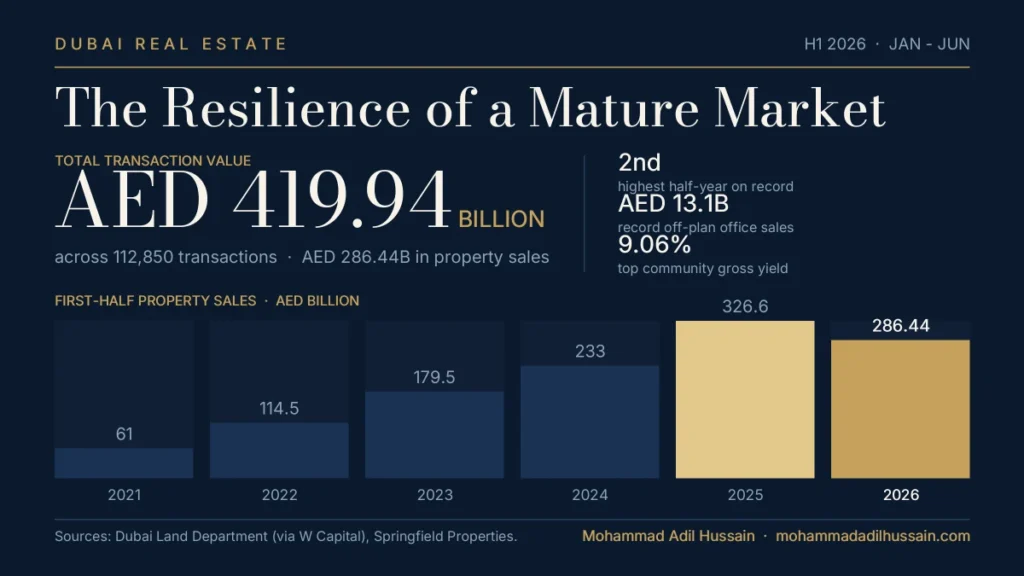
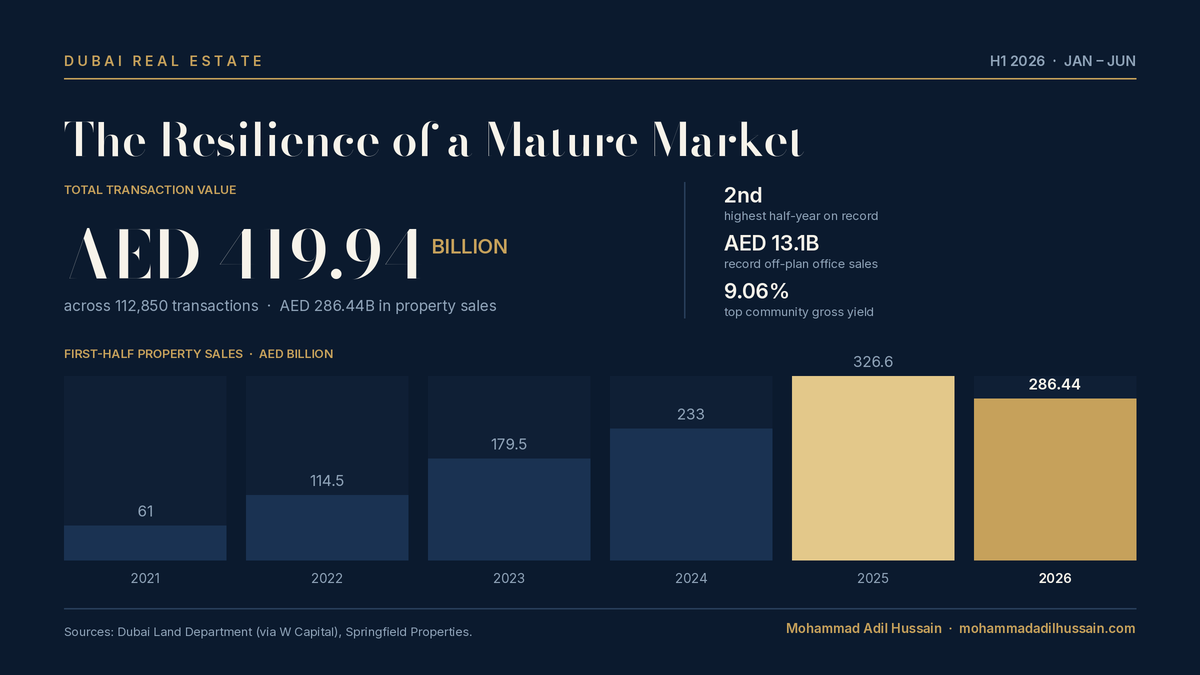 Dubai has just closed one of the strongest half-years in its property history: AED 419.94 billion in total real estate transactions across 112,850 deals.
What makes this half interesting is not the headline. It is what sits underneath it – a clear shift toward income-producing assets, a record-breaking commercial segment, and a buyer base that is behaving with more discipline than at any point in the past three years.
That combination is what a maturing market looks like. Here is what the Dubai Land Department data actually shows, and what I would be thinking about if I were allocating capital into the second half of 2026.
Quick Answer
- Dubai real estate closed H1 2026 at AED 419.94 billion, one of the strongest half-years in the market’s history.
- The market shows a clear shift toward income-producing assets, with a record-breaking commercial segment.
- The current buyer base is behaving with more discipline than at any point in the past three years, a signal of a maturing rather than overheating market.
In this guide
What does the AED 419.94 billion figure include?
It covers every transaction type – sales, mortgages and gifts – with property sales making up AED 286.44 billion of it.
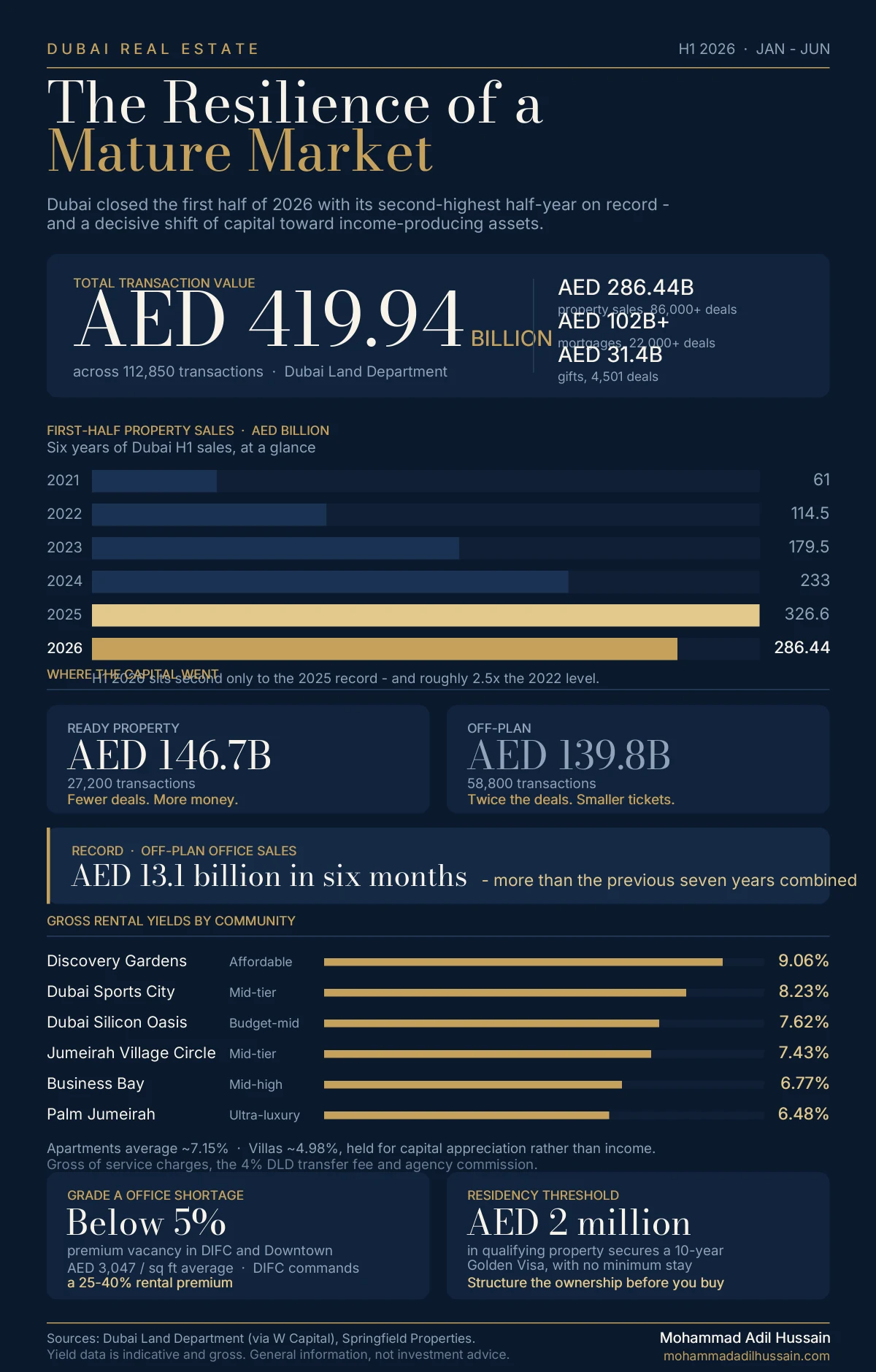
The breakdown across H1 2026: sales of AED 286.44 billion across more than 86,000 deals, mortgage transactions of over AED 102 billion across more than 22,000 deals, and gifts of AED 31.4 billion.
Worth knowing simply so you quote it accurately. The AED 102 billion mortgage figure is its own good-news story – that is a market with functioning, active credit, which is exactly what separates a durable property market from a speculative one.
Is Dubai still growing, or has it peaked?
H1 2026 was the second-highest first half on record – behind only the exceptional H1 2025 – and remains far above every year that preceded the current cycle.
Sales of AED 286 billion sit just below the AED 326.6 billion record set in H1 2025. Put that next to the years before the surge: AED 233 billion in 2024, AED 179.5 billion in 2023, AED 114.5 billion in 2022 and AED 61 billion in 2021.
So the market is trading at roughly two and a half times its 2022 level and holding within touching distance of an all-time record. That is not a market running out of steam. That is a market that reached an extraordinary peak and is now consolidating at a level that would have been unthinkable four years ago. It is the same structural strength I wrote about in why UAE real estate continues to lead global investment in 2026.
For investors, consolidation is the useful part. Peak markets reward speed; consolidating markets reward selection – and selection is where returns are actually made.
Where is capital moving right now?
Toward ready property and, most strikingly, into offices.
Ready-built properties took the largest share of sales at AED 146.7 billion across 27,200 transactions, ahead of off-plan at AED 139.8 billion across 58,800 transactions.
Look at the transaction counts. Off-plan had more than twice as many deals but less total value – a high volume of smaller tickets. Ready property drew fewer deals and more money. Serious capital is buying assets that produce rent today.
The commercial story is the standout of the half: off-plan office sales reached a record AED 13.1 billion, surpassing the previous seven years combined.
Seven years of demand, in six months. That reflects a genuine Grade A supply shortage in DIFC and Business Bay, where prime vacancy has fallen to very low levels – and it is arguably the most durable opportunity in the market right now, because supply cannot respond quickly.
Which communities are delivering the strongest yields?
Current market data puts the yield table as follows:
| Community | Gross rental yield | Segment |
|---|---|---|
| Discovery Gardens | 9.06% | Affordable |
| Dubai Sports City | 8.23% | Mid-tier |
| Dubai Silicon Oasis | 7.62% | Budget-mid |
| Jumeirah Village Circle | 7.43% | Mid-tier |
| Business Bay | 6.77% | Mid-high |
| Palm Jumeirah | 6.48% | Ultra-luxury |
Across asset types, apartments average around 7.15% while villas sit closer to 4.98% – villas are bought for capital appreciation, not income.
The pattern is exactly what you would expect from a healthy, segmented market: affordable high-density communities deliver cash flow, and prime villa districts deliver scarcity and capital preservation. Both are working. They are simply doing different jobs.
Three things I always check before relying on a published yield:
- Gross or net? Most quoted yields are gross, built from portal asking rents against asking prices.
- What are the service charges? They vary widely by building and are the single biggest gap between gross and net in Dubai. Two towers in the same community can deliver materially different net returns.
- What did acquisition cost? The 4% DLD transfer fee, agency commission and any mortgage fees all sit between the headline yield and your actual return.
None of this makes the numbers wrong. It makes them a starting point rather than a conclusion – and doing that work is usually the difference between a 9% headline and a 9% outcome. It is the same principle behind my market research and expansion advisory: test the number before you act on it.
What this means if you are investing from overseas
Foreign buyers account for a substantial share of Dubai transactions, and in my experience the property decision is usually the second decision that should be made. The first is structural:
- Personal name or corporate vehicle? Ownership structure affects succession, exit, and how the AED 2 million Golden Visa threshold is evidenced. If you are holding through an entity, the choice between mainland, free zone and offshore changes what you can own and how you exit – I compared all three in this guide to UAE structures. Restructuring later means paying transfer costs twice.
- How is the capital routed? Most countries regulate outbound investment through remittance limits, reporting thresholds or prior approvals, and the rules differ sharply depending on where you are tax-resident. Confirm what applies to you before funds move. Getting this wrong is a compliance problem, not a tax one.
- Where is the rental income taxed? The UAE does not tax personal rental income, but that says nothing about your obligations at home. If your country of residence taxes worldwide income, Dubai rental receipts are not invisible – and any UAE entity holding the asset carries its own corporate tax registration and filing obligations.
- How will the purchase be financed? Mortgage terms available to non-resident buyers differ from those offered to residents, which changes both your entry cost and your realised yield. Establish this before you shortlist properties, not after.
Get these right at the outset and Dubai property is one of the most efficient asset classes available to an international investor. Get them wrong and you spend the first two years fixing structure instead of compounding returns.
The strategic read for H2 2026
- Income-producing assets are where the conviction is. The ready-versus-off-plan value split is the clearest signal in the H1 data.
- Commercial deserves serious attention. A record office half against constrained Grade A supply is a structural opportunity, not a sentiment swing.
- Watch the delivery pipelines. Corridors receiving large completions in H2 – Dubai South among them – will see rents settle before prices do. Underwrite the yield you will have in 2028, not the one on today’s listing.
A better question than “which area gives the highest yield?”
Most investors ask: where do I get the highest return?
A better question is: what is this asset actually for – income, capital preservation, residency, or a base for my business? The answer changes the community, the asset class, the ownership structure and the holding period. Four investors can read the same H1 2026 data and each correctly reach a different conclusion.
Most consultants help you complete a transaction. I help you make informed decisions before you invest – clarify the objective, test the numbers behind the headline, and build the structure that supports both. If the plan involves an operating business alongside the asset, that extends to corporate banking and company formation as one connected decision rather than four separate errands.
Because successful investments aren’t built on headlines – they’re built on informed decisions.
If you are evaluating Dubai property as part of a wider UAE strategy, let’s start with the strategy.
Last reviewed: 27 July 2026. Transaction figures are from Dubai Land Department data as reported by W Capital. Yield figures are indicative, drawn from portal-derived market data, and are gross of service charges and acquisition costs. This is general information, not investment, tax or legal advice.
How the H1 2026 numbers should change your timeline
Reading a strong H1 report often triggers one of two reactions: rush in before prices move further, or wait for a correction that headline growth seems to make unlikely. Both instincts skip the more useful question, which is what the current data actually implies for the next twelve to eighteen months specifically, rather than for the market in the abstract.
The delivery pipeline is the part of the picture most coverage of the dubai real estate market 2026 story leaves out. A significant volume of off-plan stock sold over the past two years is scheduled to complete through late 2026 and into 2027, concentrated in specific corridors rather than spread evenly across the city. Where completions cluster, rental growth typically slows first, before any effect shows up in resale prices. That timing gap is where an informed buyer, tracking handover schedules rather than just headline transaction values, can time an entry more precisely than one reacting to the H1 report alone.
For anyone building a business around the current cycle, brokerage, property management, interior fit-out, PropTech, or short-term rental operations, the practical implication is similar. The dubai real estate market 2026 opportunity is real, but it rewards businesses positioned for the specific segment showing genuine structural demand (income-producing ready stock, Grade A commercial space) over those chasing the broadest possible slice of a market this size. A narrower, better-timed offer generally outperforms a generalist one riding the same headline growth everyone else is quoting.
None of this requires predicting the market perfectly. It requires treating the H1 figures as a starting point for a specific plan, tested against your own numbers, rather than as a justification on their own.
Financing and currency considerations overseas buyers often miss
Two practical details trip up international buyers more often than the headline numbers do. The first is financing timelines. Mortgage pre-approval for non-resident buyers typically takes longer to arrange than for UAE residents, and leaving this step until after a unit is shortlisted can mean losing a preferred property to a cash buyer while paperwork is still being processed. Arranging financing in principle before shortlisting properties removes this risk entirely.
The second is currency exposure. A property priced in AED is effectively a foreign-currency asset for anyone earning and spending in a different currency, and the AED’s peg to the US dollar means the relevant exchange rate exposure runs through USD movements against your home currency, not against the AED directly. This matters most for the financing side of the purchase and for repatriating rental income, and it is worth modelling explicitly rather than assuming the peg removes currency risk altogether, since it only removes AED-USD volatility, not the wider currency picture.
Neither point is complicated once flagged, but both are easy to miss when the focus stays on yield percentages and transaction counts alone, and both are cheap to address early and expensive to unwind after a purchase has already completed.
Whichever segment of this market you end up entering, checking these numbers against your own specific situation, rather than against the market average, is what actually separates a good outcome from a merely fashionable one.
That extra step of verification costs an afternoon and saves years of correcting an avoidable, expensive structural mistake later.
My Approach: What the Numbers Don’t Tell You
Most business setup consultants help you register a company. I help you make informed business decisions before you invest.
Numbers like AED 419.94 billion are impressive, but they describe the market, not your specific opportunity within it. Before recommending a structure for a real estate-adjacent business, brokerage, property management or PropTech, I look at where your specific model actually earns, and whether these H1 figures support or undercut that.
My advisory process focuses on helping you reduce uncertainty and make confident decisions, not just complete documentation.
What You Can Expect
- Business idea validation
- Market research
- Competitor analysis
- Business plan development
- Startup cost estimation
- Financial feasibility analysis
- Business structure recommendations
- Licence selection guidance
- Investor and employment visa planning
- Business bank account strategy
- Risk assessment
- Business expansion planning
The objective is simple: help you start your business with clarity, confidence and a long-term strategy.
Frequently asked questions
What does the AED 419.94 billion Dubai real estate figure include?
It covers every transaction type recorded by the Dubai Land Department in H1 2026 – sales, mortgages and gifts – across 112,850 transactions. Property sales accounted for AED 286.44 billion across more than 86,000 deals, mortgages for over AED 102 billion, and gifts for AED 31.4 billion.
Is the Dubai property market still growing in 2026?
H1 2026 was the second-highest first half on record, with sales of AED 286.44 billion, behind only the AED 326.6 billion set in H1 2025. That remains far above prior years: AED 233 billion in 2024, AED 179.5 billion in 2023, AED 114.5 billion in 2022 and AED 61 billion in 2021.
Where is capital moving in the Dubai property market?
Toward ready property and commercial offices. Ready-built sales reached AED 146.7 billion across 27,200 transactions, ahead of off-plan at AED 139.8 billion across 58,800 transactions. Off-plan office sales hit a record AED 13.1 billion in H1 2026, surpassing the previous seven years combined.
Which Dubai communities have the highest rental yields in 2026?
Discovery Gardens leads at 9.06% gross, followed by Dubai Sports City at 8.23%, Dubai Silicon Oasis at 7.62%, Jumeirah Village Circle at 7.43%, Business Bay at 6.77% and Palm Jumeirah at 6.48%. Apartments average around 7.15% against roughly 4.98% for villas. These are gross yields, before service charges, the 4% DLD transfer fee and agency commission.
Sources & References
What the Dubai real estate market 2026 figures mean for business
The Dubai real estate market 2026 performance is not just a property story – it is a demand signal for professional services, legal advisory, property management, PropTech and construction. When the Dubai real estate market 2026 records AED 419.94 billion in H1 alone, the ecosystem of businesses servicing that activity scales with it. For founders evaluating a UAE market entry, real estate-adjacent sectors represent some of the clearest demand visibility in the economy.